Culture · Oct 15, 2026
Abu Simbel Sun Festival, 22 October: What Dawn Really Looks Like
The twenty-minute sunbeam, the loudspeakers, the crowd — and whether the pre-dawn drive from Aswan is worth it for you.
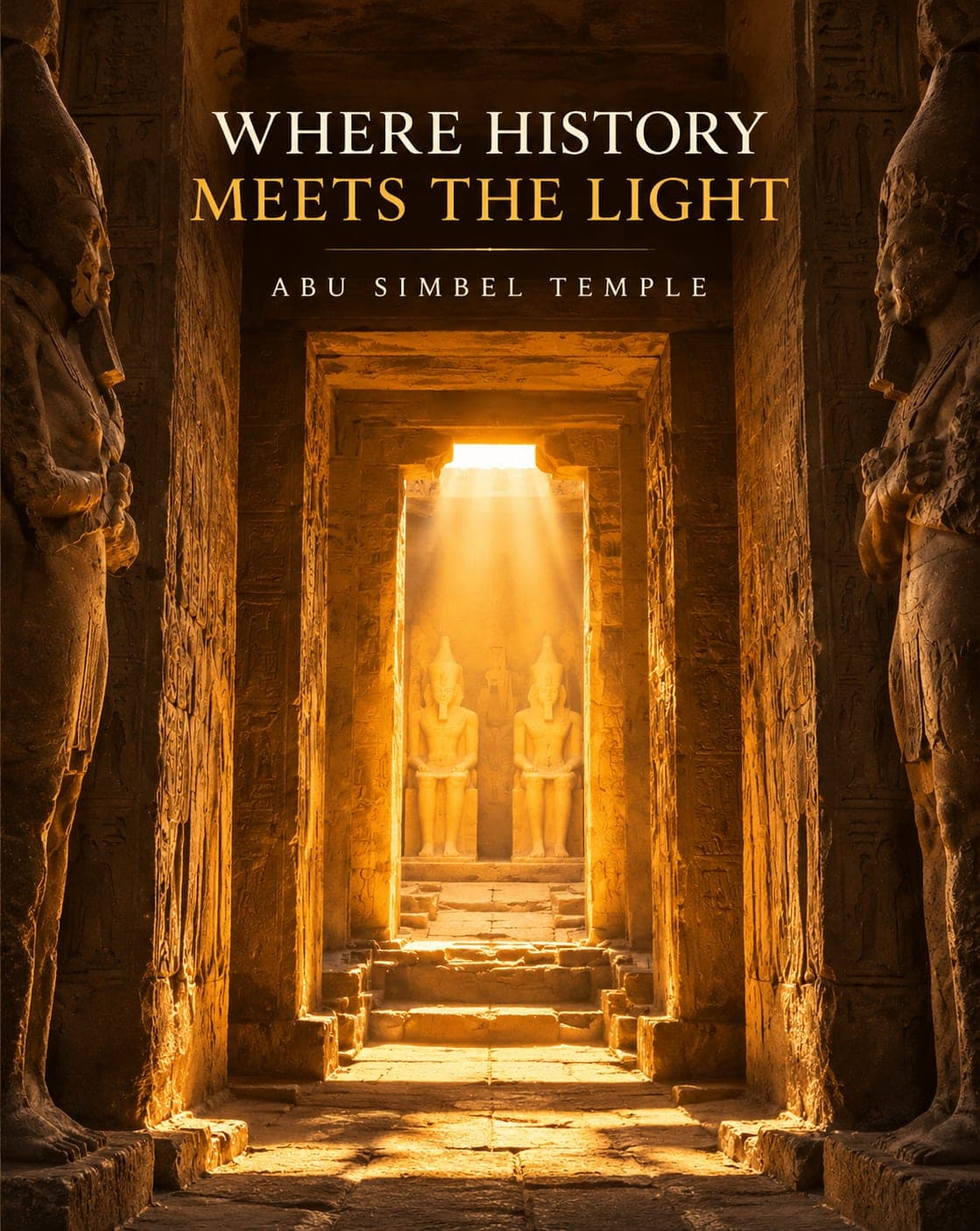
Short answer first. On 22 October the rising sun lines up with the axis of the Great Temple of Ramesses II and travels some 60 metres into the rock to light three of the four gods seated in the sanctuary. It is real, it is astonishingly precise, and it lasts about twenty minutes. It is also a national festival with thousands of people, loudspeakers, a stage, speeches and a folklore programme — not a silent mystical dawn. Almost nobody actually stands alone in the sanctuary watching the beam creep across the stone; you shuffle through in a slow queue and see it over shoulders and raised phones.
So: go if you want the occasion — the crowd, the drums, the sense of being at something Egypt turns out for — and if you are already in Aswan or willing to be there the night before. Do not go if your real wish is to meet Abu Simbel quietly, photograph the facade without a thousand people in it, or spend unhurried time inside. For that, any ordinary morning is better, and the temples do not change.
If the date fits your trip, Helios runs the event as a 22 October 2026 Abu Simbel Sun Festival trip from Aswan, bookable privately — just your party — with the entry ticket, the return transfer and a local team member handled for you.
What actually happens at dawn
You leave Aswan in the dark. The road south runs roughly 280 kilometres through flat, empty desert to the shore of Lake Nasser; vehicles tend to travel in loose convoys at that hour, and the drive takes around three hours, sometimes a little more on festival night when everyone is going to the same place at the same time. There is nothing to look at until the sky starts to lift.
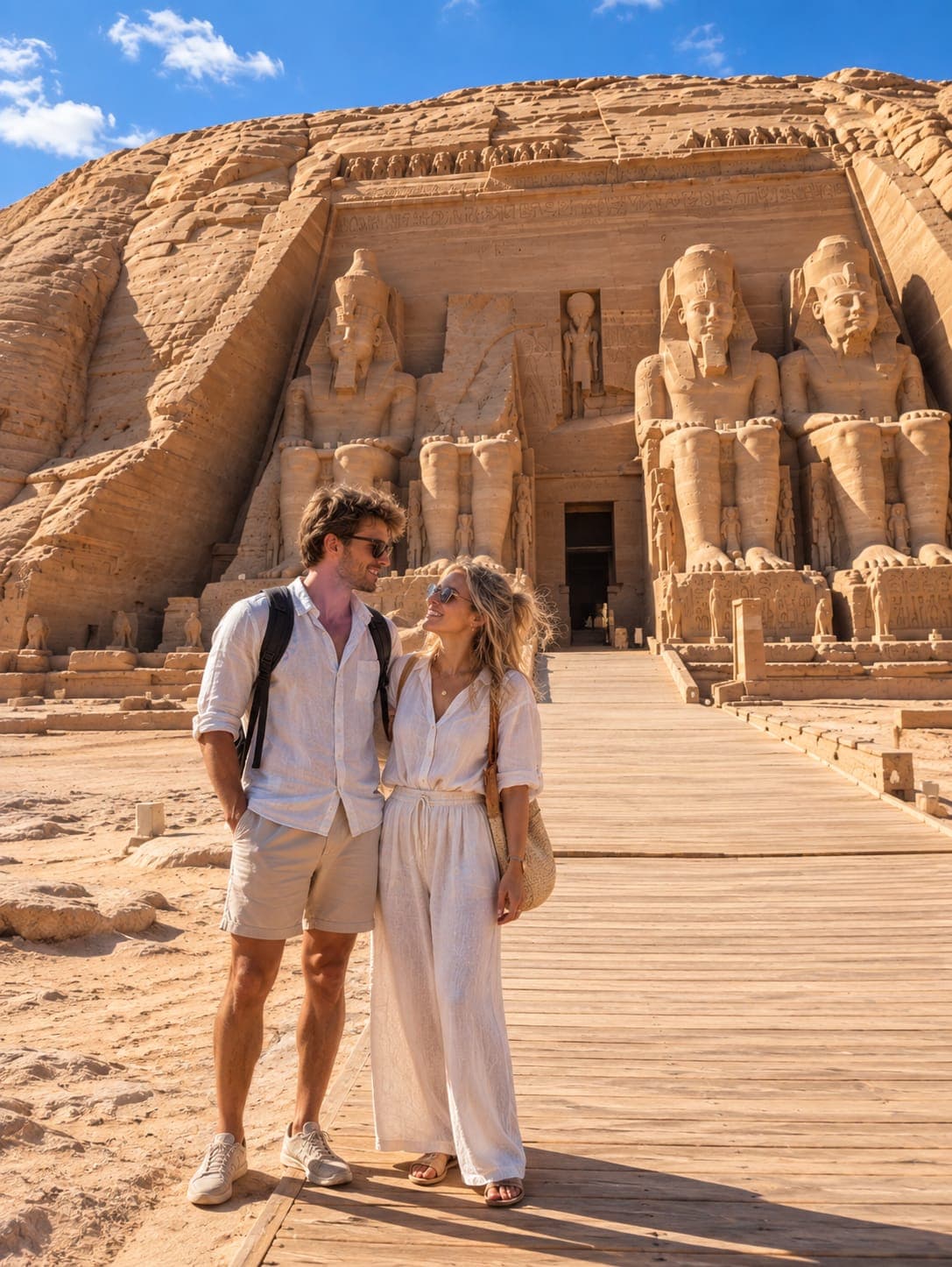
At Abu Simbel you park and walk. The approach path curves around an artificial hill — the whole site was rebuilt inside a man-made mountain in the 1960s — and the four colossi appear all at once, floodlit, facing the lake. In the dark, with cold air off the water and several thousand people already queuing, it is genuinely a scene.
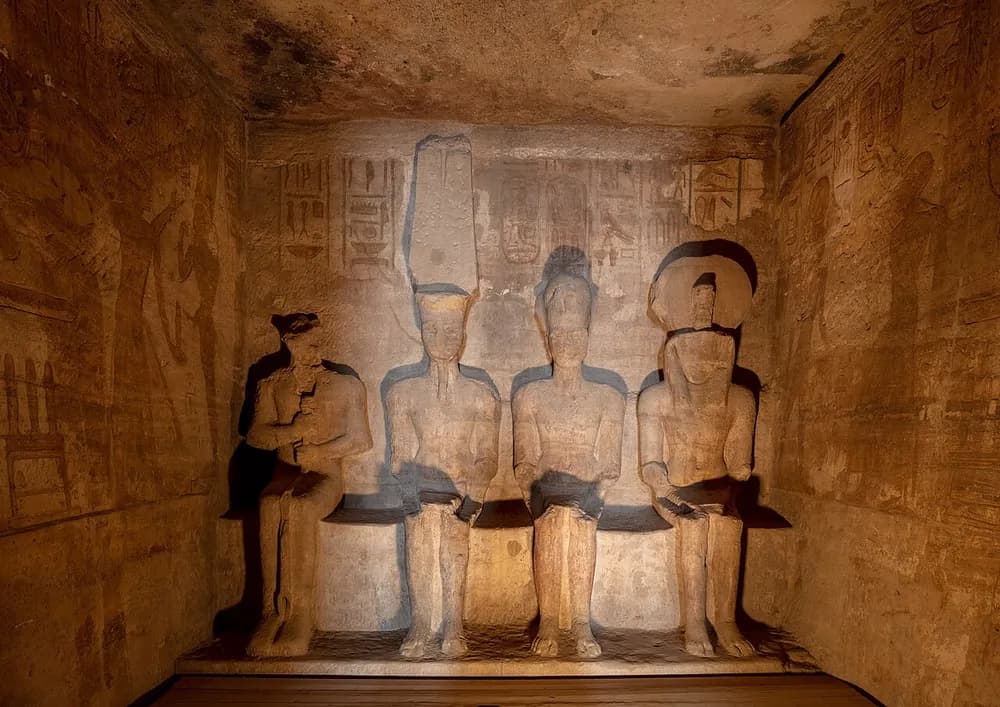
Then comes the queue. Entry into the temple is single-file and slow, and the inner sanctuary is a small chamber at the end of a long axis. Staff keep people moving, because everyone in that line wants the same twenty minutes. When the sun clears the horizon over the lake, the beam comes straight down the hall, through the pillared chamber where Ramesses stands as Osiris, and onto the back wall: Amun-Ra, Ra-Horakhty and the deified Ramesses are lit; Ptah, the god associated with the underworld and darkness, stays in shadow at the far left, exactly as the builders intended.
What nobody tells you: from where most visitors stand, you are watching the lit statues from a distance, through a tunnel of heads. The photographs that circulate are taken from a privileged position, early in the sequence, by people with press access or a great deal of patience. Your own picture will have strangers in it. Accept that in advance and the morning is wonderful; expect the magazine shot and you will be disappointed.
Outside: the festival part
While the queue moves, the forecourt fills with the other half of the event. There is a sound system, there are Nubian drums and dance troupes, there are speeches, there are television crews, there are stalls selling tea, scarves and souvenirs. It is cheerful and loud and very much a public holiday atmosphere rather than an archaeological one. Many people enjoy this more than the beam itself — it is the only time of year the site feels like a living festival instead of a monument.
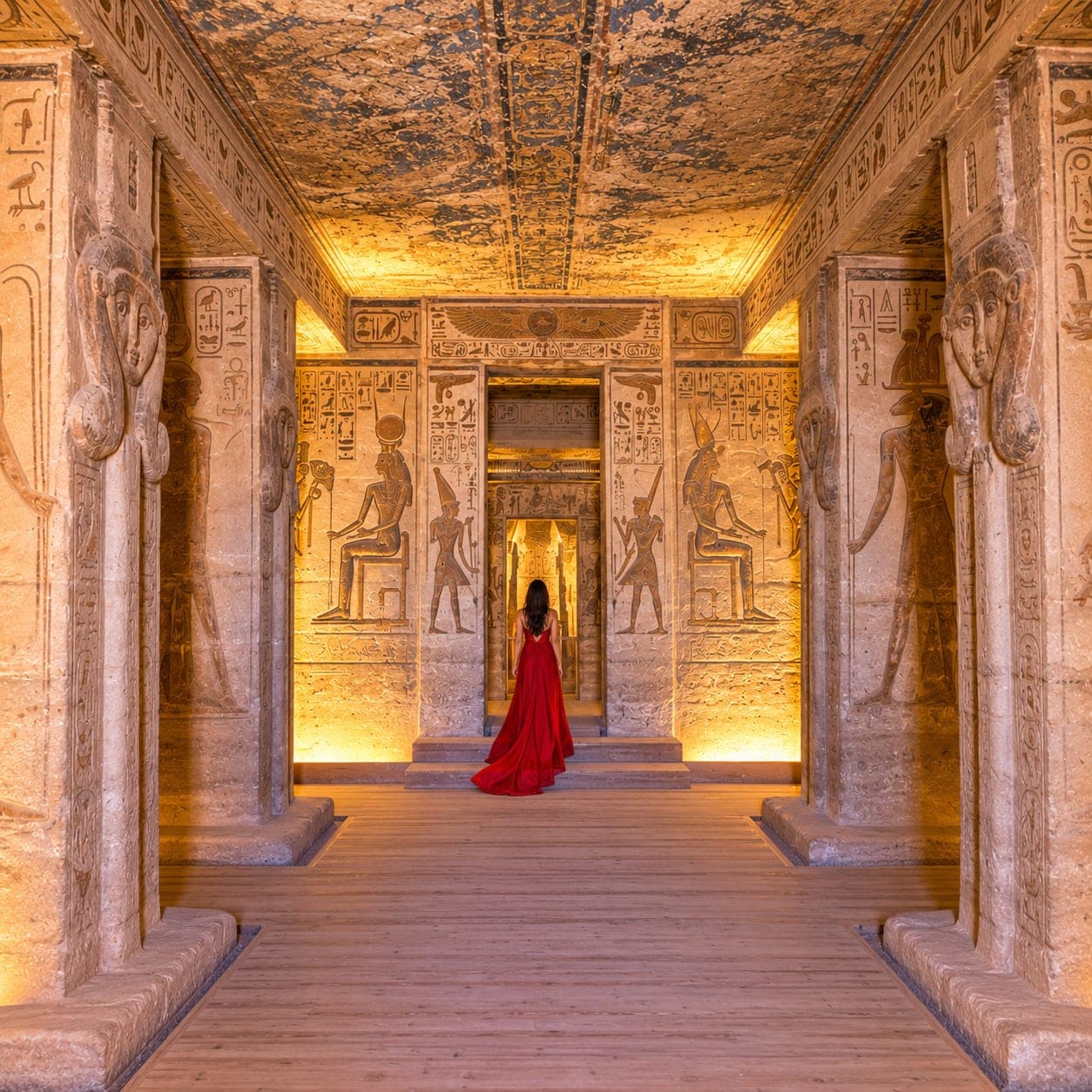
Afterwards, two things are worth doing before you leave. One: walk the short distance to the smaller temple of Nefertari, which is usually far less congested and, for many visitors, the more moving of the two buildings. Two: look at the lake. Sunrise over Lake Nasser from the terrace in front of the colossi is its own reward, and it is free of queues.
The astronomy, honestly
The temple was cut into the cliff in the 13th century BC and oriented so that twice a year the sun would penetrate the full depth of the sanctuary. The two dates fall roughly six weeks either side of the winter solstice period in the calendar sense — in practice, late February and late October. The popular explanation is that they mark Ramesses II's coronation and his birthday. That is a modern interpretation, repeated so often it sounds like fact; no ancient inscription confirms it. What is certain is the engineering: the alignment is deliberate, the exclusion of Ptah is deliberate, and it still works more than three thousand years later.
Why 22 February and 22 October rather than the 21st you may read elsewhere? Because the temple is not where it was built. When the Aswan High Dam created Lake Nasser, the entire complex was cut into blocks and reassembled on higher ground, set back from the original cliff. The reconstruction was extraordinarily accurate, but a shift of position and a slightly different horizon moved the illumination by about a day. Today the event is held on the 22nd of each month.
One practical consequence of real astronomy: the sun does not switch on and off overnight. The days immediately either side of the 22nd produce a very similar beam — not identical, but close — with a small fraction of the crowd and no loudspeakers. If what you want is the light rather than the party, that is the quiet traveller's move, and it is worth asking our team about timings when you plan your Aswan days.
The realistic timeline, from Aswan and from the Red Sea
Everything hinges on being in Aswan the night before. There is no sensible way to reach the sanctuary at sunrise from a Red Sea beach hotel on the same morning.
| Starting from | What it takes |
|---|---|
| An Aswan hotel | Straightforward. Helios's Sun Festival trip is listed as about five hours in total, pickup from your hotel, with the ticket and the return private transfer included. The listing shows a 17:00 start time; the departure for the alignment itself is in the small hours, so confirm your exact pickup time with the team when the booking is confirmed. |
| Hurghada, El Gouna, Makadi, Safaga | You need a night in Aswan first — by road or by air. For the February alignment, Helios lists the event from the Red Sea coast as the 22 February 2027 Sun Festival, also private, also with pickup from an Aswan hotel. |
| Luxor or a Nile cruise | Possible, but it means an extra transfer south. If you are weighing the two cities at all, our comparison of Luxor or Aswan when you only get one is the honest version. |
Note what the event trip is and is not: it covers the ticket, the private return transfer and on-the-ground assistance. Food and drink at the venue and any gratuities are not included — bring what you want to eat, because the pre-dawn hours are long and the stalls are busy. Tickets are subject to availability and we confirm your booking before payment.
Building it into a proper Nubia itinerary
The festival on its own is a sunrise and a scrum. The temples deserve a guide and unhurried time, and Aswan deserves a day of its own — Philae on its island, the High Dam, the Unfinished Obelisk still lying in the granite quarry where it cracked.
Two Helios tours get you there properly, both private:
- Aswan & Abu Simbel — 2 Days of Nubia's Greatest Temples runs by road from the Red Sea coast with a 05:30 start, a night in Aswan, all meals, entrance fees and an Egyptologist throughout. It is a long day of driving each way; the Good to know section says so plainly, and so do we.
- Cairo, Aswan & Abu Simbel by Plane — 3 Days trades the road for flights and adds Giza and the Grand Egyptian Museum. Far less time in a vehicle, considerably more ground covered.
If you want the festival and a guided Nubia itinerary, ask our team to line the dates up rather than assuming they interlock — the event has its own ticket and its own clock. For a broader sense of how Aswan's sights fit together across two days, see our guide to Aswan in two days: Philae, the High Dam, Abu Simbel, and if you are still deciding how to travel Upper Egypt at all, Nile cruise or land tour lays out what each one actually buys.
Who should skip the festival and go on a normal morning
Be honest with yourself about four things.
- Mobility and standing. The queue is long, on uneven ground, in the dark, with no seating and limited shade later. If standing for an hour or more is hard, this is not your morning.
- Children. Woken in the middle of the night, driven three hours and asked to queue — most under-tens will not forgive you, and the beam means nothing to them. Our notes on Egypt with children cover what works at which age.
- Photography. If a clean image of the facade or the sanctuary matters to you, come on an ordinary day, ideally after the first wave of arrivals has cleared.
- Early starts. This is a genuinely hard night. If you already know that a pre-dawn alarm ruins the following day, read how we frame the same trade-off for the Luxor balloon flight and decide which one you would rather spend your sleep on.
On any ordinary day, Abu Simbel is still one of the great sights on earth — four twenty-metre kings, a hall of Osiride pillars, battle reliefs of Kadesh covering the walls, and Nefertari's temple next door with its own facade of colossi. None of that depends on 22 October.
Practical notes for the night itself
- It is cold before dawn. Desert nights in late October drop a long way below the daytime figures. A jacket or a fleece, plus something for the drive back when the sun is high and the vehicle is warm. Our packing guide by season and trip type goes further.
- Dress for a crowded religious-heritage site and a national audience: shoulders and knees covered is the easy, comfortable choice. See our etiquette notes.
- Carry small cash for tea, water and the people who help you through the morning. How much, and when not to, is covered in tipping in Egypt.
- Be on time at the pickup point. Venue entry closes before the alignment; there is no catching up with a sunrise.
- Plan the rest of your October carefully. Late October is the start of Egypt's best travel months — our month-by-month guide explains why the south is comfortable then and brutal in summer.
And if you are the kind of traveller who plans a trip around a sky event, the other one on Egypt's horizon is larger still: the total solar eclipse over Luxor in 2027, six minutes of darkness above the Valley of the Kings. The Sun Festival is the warm-up act for the same instinct — standing somewhere ancient at exactly the right moment.
FAQ
How long does the sunbeam actually last?
Around twenty minutes from the moment the light enters the sanctuary until it slides off the statues. You will not have twenty minutes in front of it yourself — the queue is kept moving so that everyone gets a view.
Why is it 22 October and not 21 October?
The original alignment fell a day earlier. When the temple was dismantled and rebuilt on higher ground to save it from the rising waters of Lake Nasser, its position and horizon changed slightly, shifting the illumination by about a day. The event is now held on 22 February and 22 October.
Can I see the alignment without the festival crowd?
The days immediately before and after produce a very similar — not identical — beam with far fewer people and no stage programme. If the light matters more to you than the ceremony, plan your Aswan days around that and ask our team how to time the visit.
Is the Helios Sun Festival trip private or shared?
Both the October 2026 and February 2027 event trips are offered in a private format — just your party, whatever its size — with the entry ticket and return private transfer included. Food and drink at the venue and gratuities are not.
Can I do the festival as a day trip from Hurghada?
Not on the same morning. Both event trips are picked up from an Aswan hotel, so you need to be in Aswan the night before — by road with the two-day Nubia tour, by air with the three-day flight itinerary, or under your own arrangements.
Book what you just read about
Explore related tours and check each trip for available booking options and inclusions.