
Destinations · Oct 9, 2026
The Mask of Tutankhamun: Where the Original Is Now and How to See It
Gold, lapis and a glued beard: the facts behind Egypt's most famous object, and a day trip from Hurghada to see it in Giza
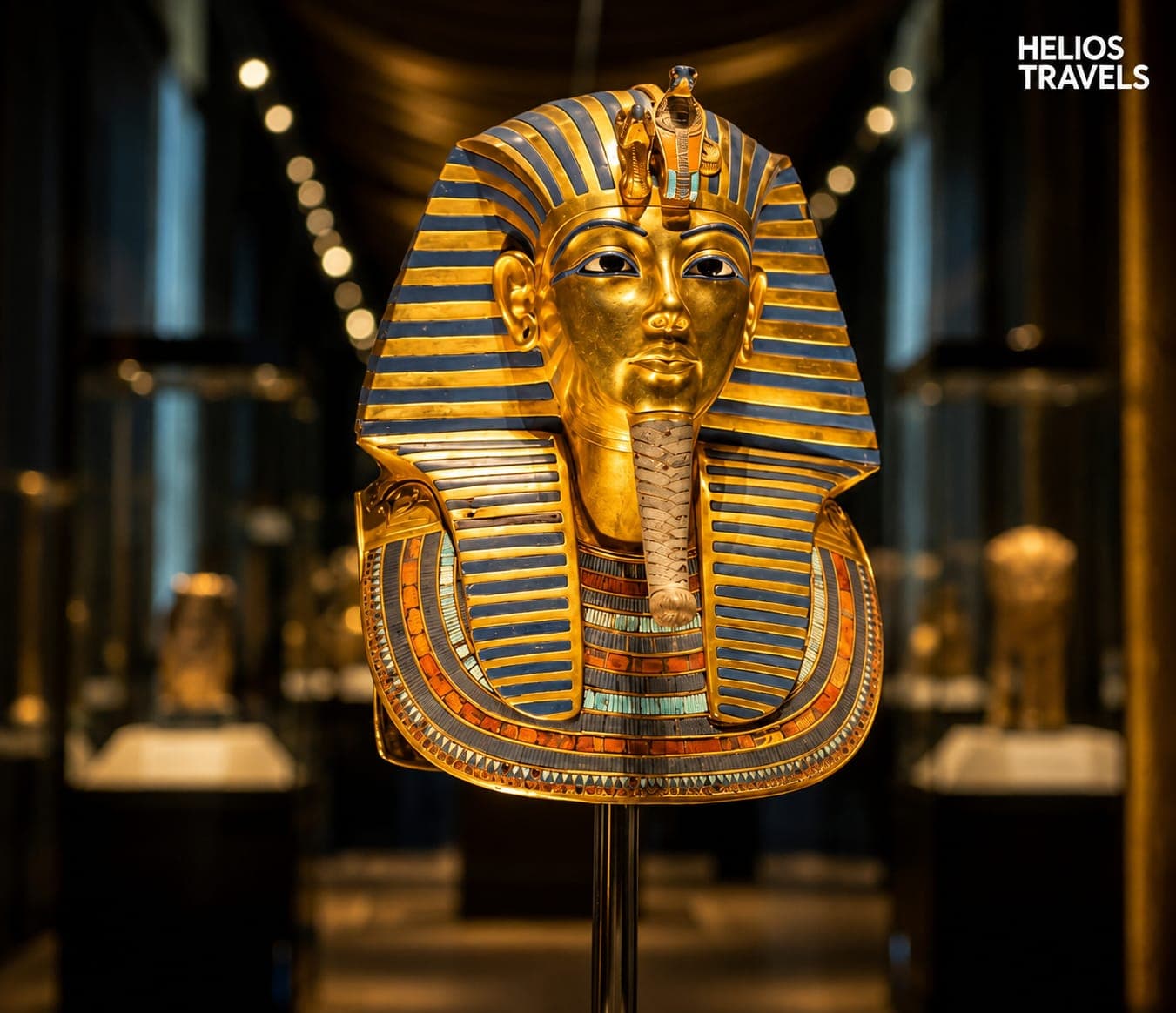
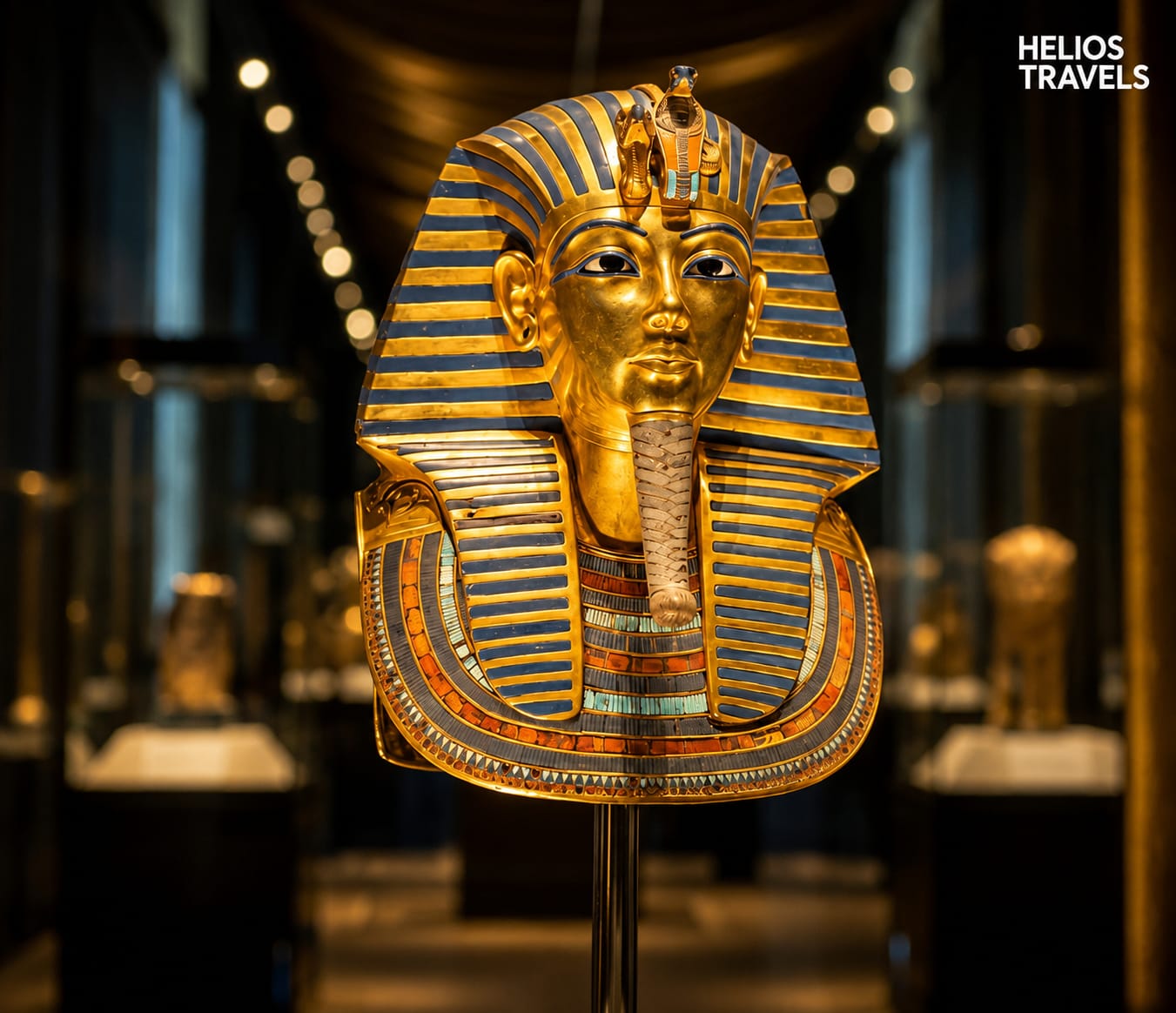
Almost every guest who books a Cairo day with us asks the same question on the bus: is the golden mask of Tutankhamun really there, and is it the original? Yes, and yes. Since 2025 the mask no longer stands in the old Egyptian Museum on Tahrir Square. It is in the Grand Egyptian Museum in Giza, a few minutes from the pyramids. This guide explains what the mask is made of, how it was found, what it is "worth", the beard accident, the theory that it was made for someone else — and how to see it from Hurghada without wasting the day.
The Grand Egyptian Museum in Giza, the mask's home since 2025
What is the mask of Tutankhamun?
It is the funerary mask that covered the head and shoulders of the mummy of Tutankhamun, a pharaoh of the 18th Dynasty who came to the throne as a boy and died young, around 1323 BC. The mask shows the king idealised, wearing the striped royal headcloth (the nemes) with a cobra and a vulture on the brow and a braided divine beard at the chin.
It was not decoration. Egyptians believed the mask helped the dead king's spirit recognise its body. On the back and shoulders runs a protective spell from the Book of the Dead (spell 151) that names parts of the face and links them to gods.
What is the mask made of — and how heavy is it?
The mask is made of beaten sheets of high-carat gold. Analyses show two different alloys: a lighter one for the face and neck, and a slightly different one for the rest. The gold is inlaid with semi-precious stones and coloured glass:
- Lapis lazuli around the eyes and for the eyebrows
- Quartz for the whites of the eyes and obsidian for the pupils
- Carnelian, turquoise and amazonite in the broad collar
- Coloured glass and faience, including the blue stripes of the headcloth
The mask is about 54 cm tall and weighs 10.23 kg — a little over ten kilograms of mostly solid gold. The separate beard, attached by a tube, adds weight of its own. Photos make it look larger than it is; standing in front of it, most people are surprised how close to life-size it feels.
Who found the mask, and when?
The British archaeologist Howard Carter, funded by Lord Carnarvon, found the entrance to tomb KV62 in the Valley of the Kings near Luxor in November 1922. The tomb was small but almost intact — the reason Tutankhamun is famous, rather than any great deeds in his short reign.
Emptying it took years. The mask itself was only seen on 28 October 1925, when Carter's team opened the innermost of three nested coffins. It had rested on the king's mummy for roughly 3,250 years. The mummy is still in the tomb in the Valley of the Kings today; the mask and almost all the treasures went to Cairo.

The Valley of the Kings near Luxor, where Tutankhamun's tomb was found
Where is the mask of Tutankhamun now?
The original is in the Grand Egyptian Museum (GEM) in Giza, on the western edge of Cairo, close to the pyramids. For nearly a century it was the star of the Egyptian Museum on Tahrir Square in central Cairo. In 2025 the last Tutankhamun objects, the mask among them, were moved to the GEM; the Tutankhamun hall at Tahrir closed in October 2025.
The GEM was inaugurated on 1 November 2025 and opened to the public a few days later, on 4 November. For the first time, the whole Tutankhamun collection — over 5,000 objects, of which only about 2,000 were ever shown at Tahrir — is displayed together in dedicated galleries, with the mask at their centre. As of autumn 2026 that is where it stands.
If you visit the old museum on Tahrir Square, which is still open and still worth it for other collections, you will not find the mask there any more. Some older guidebooks and websites have not caught up.
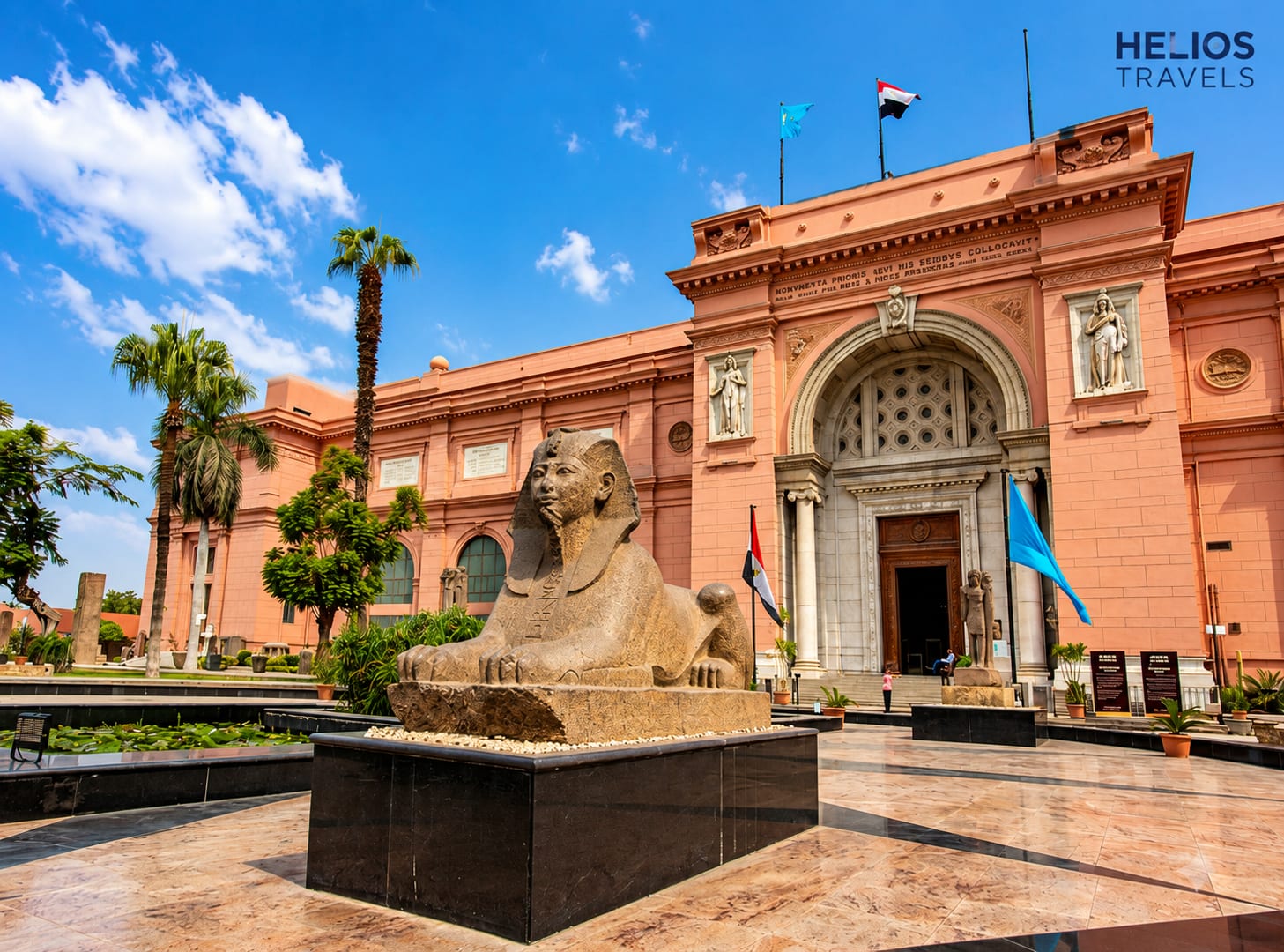
The Egyptian Museum on Tahrir Square, Cairo, the mask's home for nearly a century
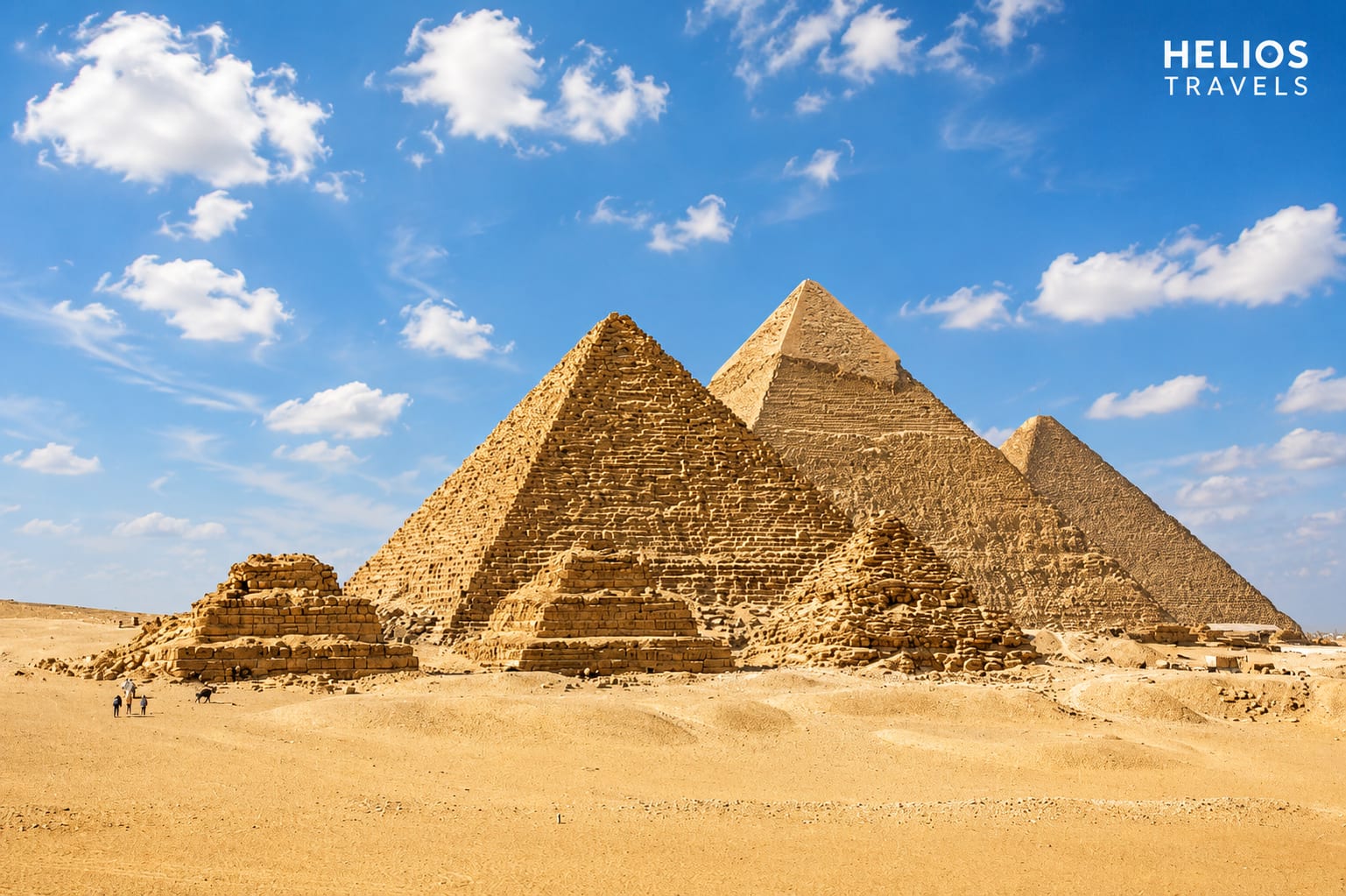
Book what you just read about
Explore related tours and check each trip for available booking options and inclusions.

