
Culture · Oct 11, 2026
Sheikh Zayed Grand Mosque: Dress Code and Visitor Guide
What to wear, how to book, how to behave inside and what to look at in Abu Dhabi's great white mosque

Most people who visit Abu Dhabi come for one building. The Sheikh Zayed Grand Mosque sits on raised ground at the edge of the city, white marble on every surface, with domes and minarets you can see from the motorway long before you arrive. It welcomes visitors of every faith, and that openness is part of why it was built. But it is a working mosque first, with prayers five times a day and rules that staff enforce politely and without exception. This guide covers what to wear, how entry works today, how to behave inside, what to look at once you are there, and how to fit a visit into a day trip from Dubai.
A short background
The mosque carries the name of Sheikh Zayed bin Sultan Al Nahyan, the founder of the United Arab Emirates, who led the union of the seven emirates in 1971 and died in 2004. He wanted a mosque that would show Islam as a faith of moderation and bring together craft traditions from across the Muslim world. Construction began in 1996 and the prayer halls opened for worship at Eid al-Adha in 2007. Artisans and materials came from many countries, among them Italy, Germany, Morocco, India, Turkey, China, the United Kingdom, New Zealand and Greece. Sheikh Zayed is buried on the grounds, and the Quran is recited at his mausoleum around the clock by reciters who take turns through the day and night. At full capacity the mosque holds around 50,000 worshippers.
The dress code, for women and men
This is the question everyone asks, and the rules are clear. The mosque's own visitor regulations ask for modest clothing that reflects local custom.
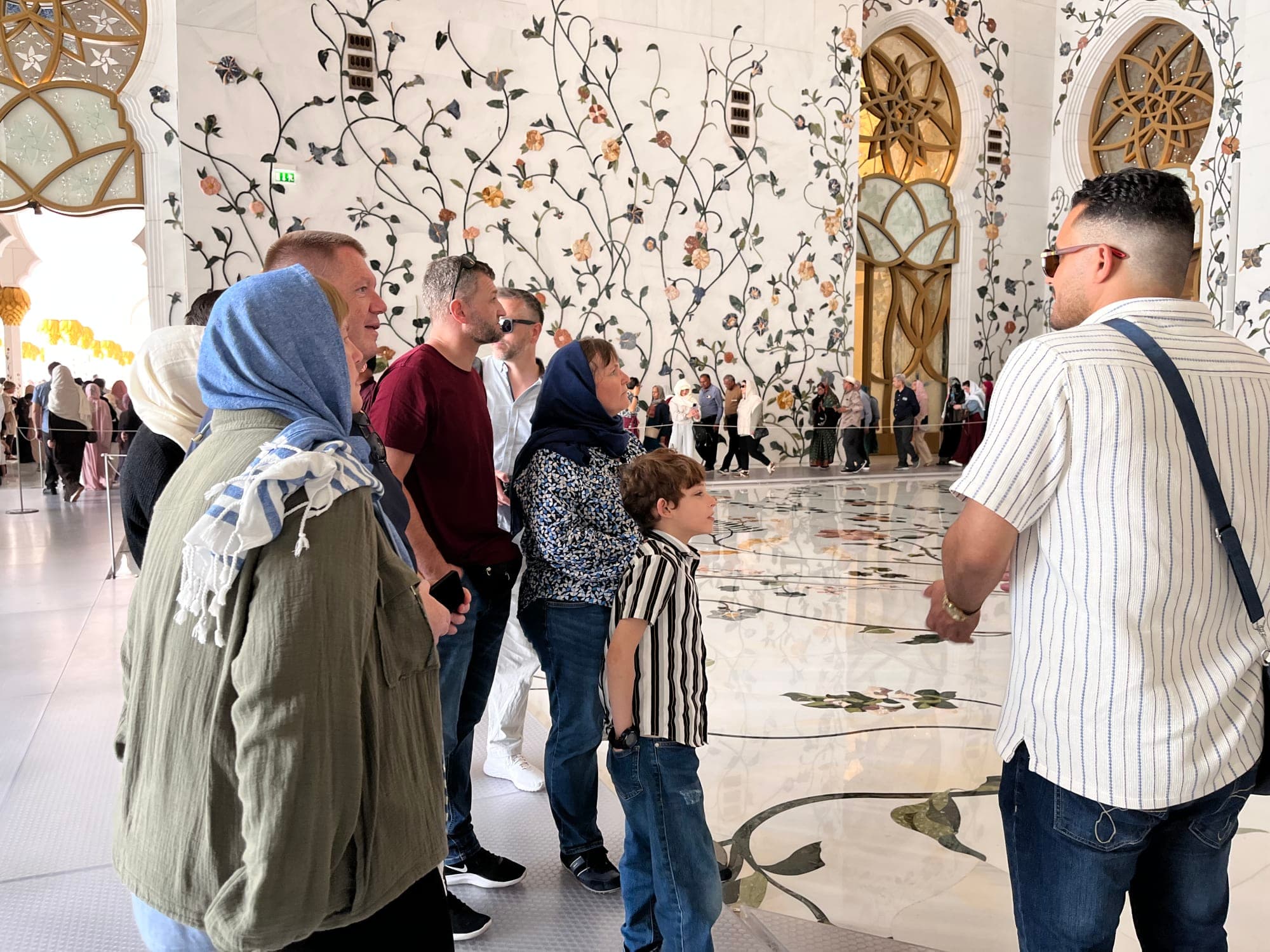
- Women: loose clothing that reaches the ankles, sleeves down to the wrists, and a scarf that covers all of the hair. Nothing tight, transparent or revealing. A long, loose dress or wide trousers with a long tunic both work, as long as the fabric is not sheer.
- Men: long trousers that cover the legs, and a top with sleeves. Sleeveless shirts, tight or see-through clothing are not accepted. Shorts will get you turned away.
- For everyone: the mosque asks visitors to avoid heavy make-up, a lot of jewellery, very bright colours and clothes printed with slogans or pictures.
- Children follow the same idea of modest, covering clothes.
Shoes come off before you enter the prayer halls, so wear something you can slip off and on without sitting down. Socks are fine on the marble, but it can be slippery, so walk carefully.
Our advice is simple: bring your own suitable clothes and a scarf rather than counting on borrowing something at the door. A headscarf that keeps slipping is the most common problem we see, so a scarf you can pin or tie securely saves a lot of adjusting. In the summer months a light cotton or linen layer is far more comfortable than synthetic fabric.
How entry works today
The mosque asks visitors to pre-book their visit and obtain an online access pass through its official website, szgmc.gov.ae, and an admission fee applies. Worshippers coming to pray enter without a ticket. Tour groups book their visits in advance through registered operators, so if you come with a guided tour the group's visit is arranged as part of the programme.
Visitors pass through a security check at the entrance, with separate lanes for women and men. Bags are inspected, and a number of items are not allowed in: food, anything that can start a fire, electronic cigarettes, sharp objects, flags and banners, and also dolls and stuffed toys, which surprises many parents. Smoking is not permitted anywhere on the grounds. The mosque provides wheelchairs on request for elderly visitors and people with disabilities, and small electric carts run between the car parks and the starting point of the visit.
The mosque is open to visitors every day from the morning into the evening. On Fridays it closes to visitors around the midday prayer, and during Ramadan the hours change completely. Opening times are adjusted from time to time, so check the official website in the week before your visit rather than relying on a time printed elsewhere.


Book what you just read about
Explore related tours and check each trip for available booking options and inclusions.
Sheikh Zayed Grand Mosque Half Day from Dubai
5 hours · Dubai
€53/ person
See the tour
Sheikh Zayed Grand Mosque Guided Walk
2 hours · Abu Dhabi
€22/ person
See the tourGrand Mosque and Louvre Abu Dhabi from Dubai
9 hours · Dubai
€95/ person
See the tour
Abu Dhabi City Tour: Mosque, Palace and Towers
6 hours · Abu Dhabi
€64/ person
See the tour
