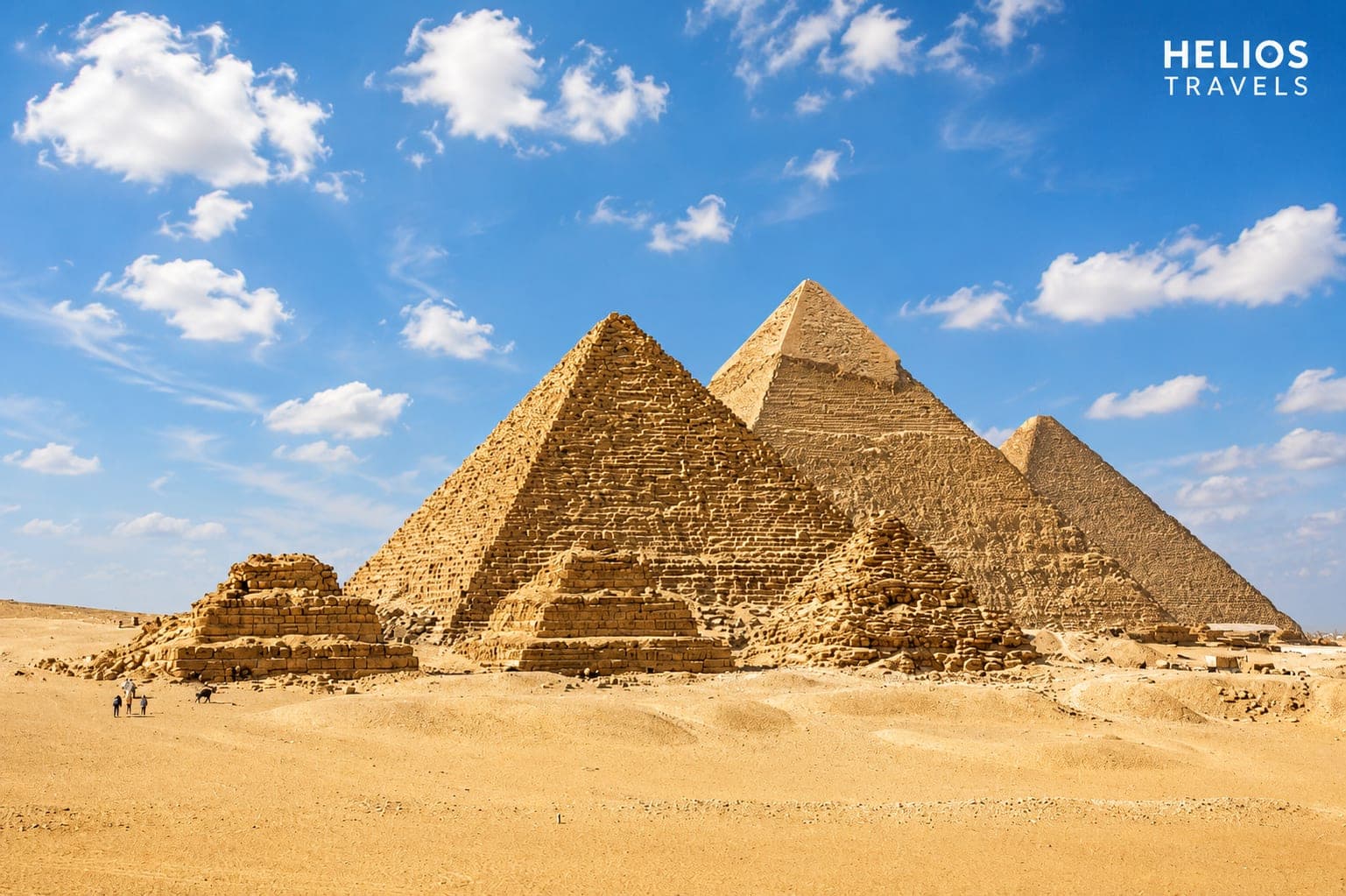
Khafre — Chephren in the Greek spelling — built the second pyramid at Giza, the one that looks like the tallest in nearly every photo. It isn't. This guide covers who Khafre was, how his pyramid is built, what is inside it, whether you can go in today and what that is honestly like, and how it compares with going inside Khufu's or Menkaure's pyramid. We take guests from Hurghada to Giza several times a week, so the practical part comes from standing in that queue, not from a brochure.
Who was Khafre?
Khafre was a king of Egypt's Fourth Dynasty, in the Old Kingdom. He was a son of Khufu, the builder of the Great Pyramid, and came to the throne after his brother Djedefre. Most Egyptologists date his reign to roughly 2558–2532 BC, about 24 to 26 years. The ancient chronicler Manetho gave him far longer, which nobody takes literally.
His son Menkaure later built the third and smallest of the main Giza pyramids. So the three famous pyramids are the work of a father, a son and a grandson — one family project spread over three generations.
Greek writers such as Herodotus, visiting some two thousand years later, described Khafre as a tyrant who closed the temples. Archaeology gives no support to that. It tells us more about the stories local guides told Greek tourists than about the king.

The Giza Pyramids: three generations of one royal family in stone
How big is the Pyramid of Khafre?
- Original height: about 143.5 m. Today about 136.4 m, because the capstone and part of the outer layer are gone.
- Base: about 215 m per side.
- Slope: about 53 degrees — a little steeper than the Great Pyramid.
For comparison, Khufu's Great Pyramid was originally about 146.6 m tall with a base of about 230 m. Khafre's pyramid is smaller in every dimension.
Why does it look taller than the Great Pyramid?
Two reasons. First, it stands on bedrock about 10 m higher than Khufu's, so its tip sits higher above the plateau. Second, its steeper angle and the surviving cap of casing stones make the summit look sharp and pointed, while the top of Khufu's pyramid is flattened and stepped.
From most viewpoints, including the panorama point where everyone takes the classic photo of all three, Khafre's pyramid wins the eye. The tape measure says otherwise.
The casing stones at the top
The pale "cap" near the summit is the pyramid's best-known feature. It is what remains of the original casing: smooth, fine white limestone from the Tura quarries on the other side of the Nile, which once covered all the pyramids at Giza. Over the centuries most of it was stripped off and reused as building stone. On Khafre's pyramid the upper part survived.
The lowest courses of the casing were pink granite brought from Aswan, and a few of these blocks can still be seen near the base. Look at the cap and imagine the plateau as it was: three smooth, bright surfaces, not the stepped piles of blocks we see now.
The valley temple, the causeway and the Sphinx
A pyramid was never a stand-alone building. Khafre's complex had a mortuary temple against the pyramid's east face, a causeway almost 500 m long running down the slope, and a valley temple at the edge of the desert. A small satellite pyramid stood on the south side.
The valley temple is the best-preserved part, and you should not skip it. It is built of massive red granite blocks around a hall with square granite pillars. Sockets in the floor once held 23 statues of the king. In 1860 Auguste Mariette found nine complete statues here; one of them, the seated Khafre with the falcon god Horus spreading his wings behind the king's head, is among the most famous sculptures of ancient Egypt and belongs to Cairo's museum collections.
The causeway runs right past the Great Sphinx. Because of that layout, many Egyptologists attribute the Sphinx to Khafre and read its face as his. It is a strong argument, but it is not proven, and your guide may mention other views. What is certain is that the Sphinx and Khafre's valley temple share one piece of landscape — the usual route to the Sphinx terrace leads through the temple.
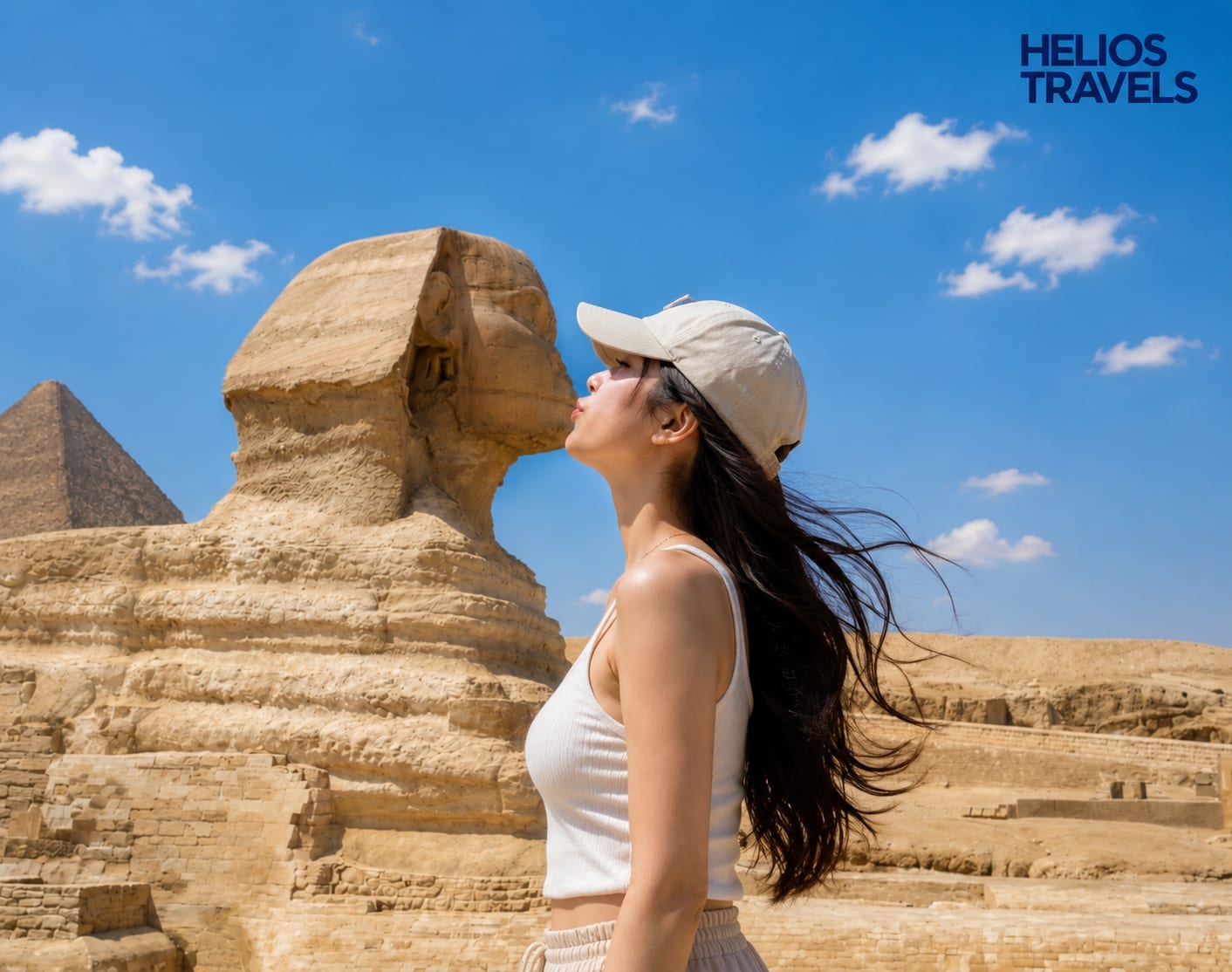
The Great Sphinx of Giza, beside the causeway of Khafre's complex
What is inside the Pyramid of Khafre?
Much less than inside the Great Pyramid, and that is part of its character. There is no grand gallery, and there is not a single inscription.
- Two entrances, both on the north face: one about 11.5 m up the face, the other at ground level.
- From each, a passage slopes down. The upper one is lined with granite; the lower one is cut into the bedrock and once had a stone portcullis.
- Off the lower passage, a short side passage leads to a small subsidiary chamber. Nobody knows for certain what it was for — perhaps storage.
- The passages meet and run level to the burial chamber, cut largely into the rock and roofed with huge gabled limestone blocks. It measures about 14 by 5 m.
- Near the west wall lies a sarcophagus of dark granite, sunk into the floor. It is empty.
No firm evidence has ever been found that Khafre was actually buried here.
Belzoni and his graffiti
The modern rediscovery belongs to Giovanni Belzoni, a circus strongman from Padua turned explorer. On 2 March 1818 he found the original entrance on the north side, hidden under debris, and pushed through to the burial chamber. He found the sarcophagus open, its lid broken, and a few animal bones inside. The pyramid had been entered and robbed long before him.
Belzoni recorded his success directly on the chamber wall in large letters: "Scoperta da G. Belzoni 2. mar. 1818" — "Discovered by G. Belzoni". It is still there, and for many visitors it is the most memorable thing in the room. Today we would call it vandalism; by now it has become a piece of history itself.
Can you go inside the Pyramid of Khafre today?
Sometimes. The antiquities authorities open the pyramid interiors in rotation and close them for conservation, and the arrangement changes from season to season. In some periods Khafre's interior is open on a separate ticket; in others it is closed or only available by special arrangement.
Interior tickets are always extra to the plateau entry, sold in limited numbers, and in high season (December to February) they can be gone by late morning. So we do not promise any particular interior in advance. Prices change; ask us when you book, and we check what is open on your date.
What is it like inside? An honest description
- You walk bent double. The sloping passage is low. An adult goes down hunched over or half crouching for a good stretch, and climbs back the same way.
- It is warm and humid. Many visitors share the same air. Even in winter you come out sweating; in summer it is hard work.
- The chamber is bare: rock, limestone gables, the sarcophagus in the floor, Belzoni's graffiti. There is nothing to "see" in the museum sense. What you get is the feeling of standing inside a 4,500-year-old mountain of stone.
- A visit takes 10 to 20 minutes, depending on the queue in the passage.
Who it is not for: anyone with claustrophobia, bad knees or a bad back, heart or breathing problems, or anyone who has to be talked into it. There is no shame in staying outside — the exterior, the valley temple and the Sphinx are the bigger story anyway.
Khafre, Khufu or Menkaure: which interior?
- Khufu (Great Pyramid): the most impressive interior, with the Grand Gallery and the granite King's Chamber. Also the longest climb, the most crowded and the most expensive of the interior tickets.
- Khafre: a shorter, simpler route, downhill on the way in. The reward is the sunken sarcophagus and Belzoni's graffiti. Often quieter.
- Menkaure: the smallest pyramid, with a steep descending passage to rock-cut rooms, one of them with carved panelling. Usually the least crowded.
If you want one interior and you are fit, choose Khufu. If you want the experience without the long climb, take Khafre or Menkaure — whichever is open on the day. For most people, one interior is enough.
9 facts about the Pyramid of Khafre
- It is the second-largest pyramid at Giza, yet looks the largest because it stands on bedrock about 10 m higher.
- It is the only Giza pyramid that kept a large patch of its original white casing near the top.
- Its lowest casing course was pink granite from Aswan, around 800 km to the south.
- It has two entrances on the north face, one above the other.
- There is not a single inscription inside.
- The granite sarcophagus is sunk into the floor of the burial chamber.
- Belzoni's graffiti of 2 March 1818 is still on the chamber wall.
- Its causeway runs past the Great Sphinx, which is why many link the Sphinx to Khafre.
- Nine complete statues of the king were found in his valley temple in 1860.
Practical tips for your visit
- Go early. Interior tickets are limited and the morning is cooler.
- Wear flat, closed shoes. The passages have wooden ramps with cross-slats and you will be stooping.
- Travel light. Leave big bags in the vehicle; bring water for afterwards, not for the passage.
- Plan one loop: pyramid, panorama point, valley temple, Sphinx. That takes one to two hours without rushing.
- From Hurghada it is a long day. Giza is roughly five to six hours each way by road.
Our shared Cairo day trip from Hurghada covers the Grand Egyptian Museum, the pyramids and the Sphinx; the Cairo day trip by road is the private version. If pyramids are the reason you are going, the exclusive Giza, Saqqara and Dahshur tour adds the older pyramids south of Giza, and Cairo in 2 days gives you the plateau without the long drive back the same evening.
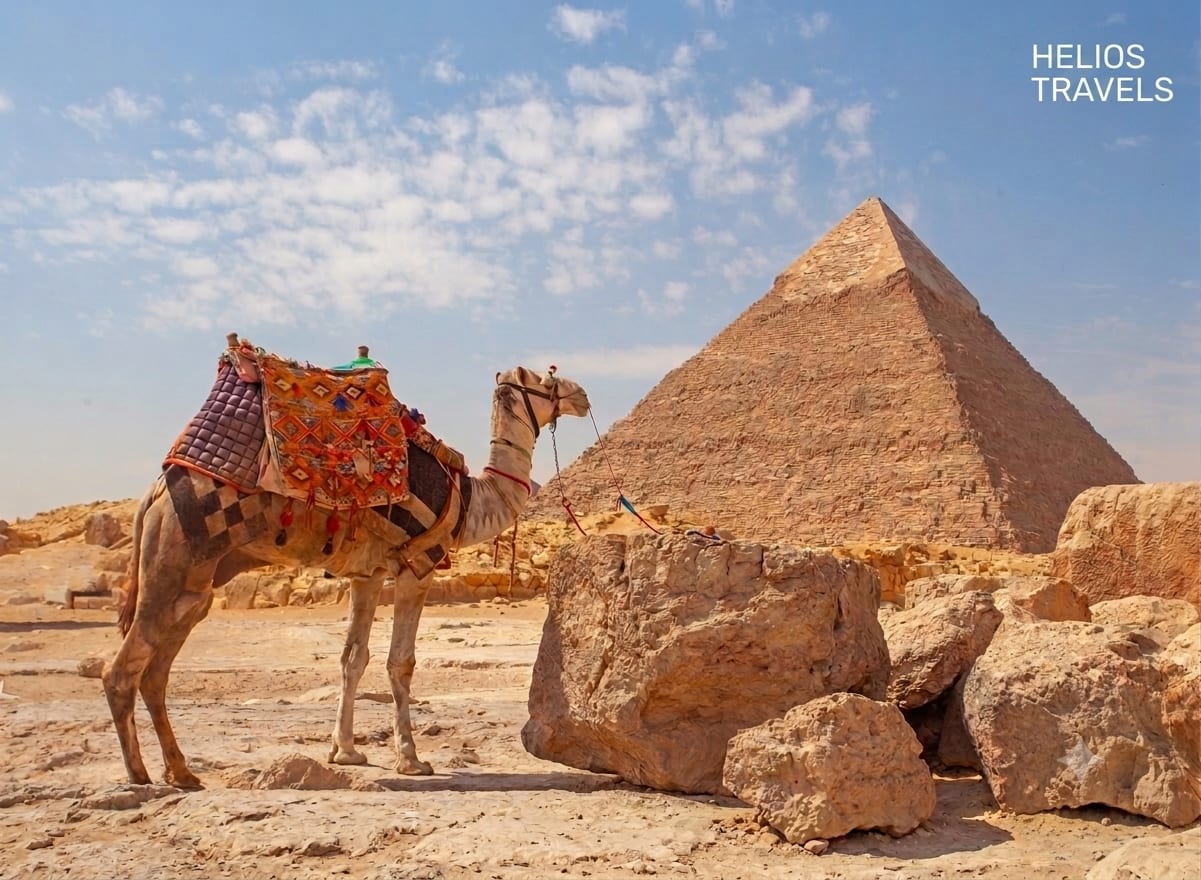
The Giza Pyramids: go early, before the interior tickets run out
FAQ
Is the Pyramid of Khafre taller than the Great Pyramid?
No. It was about 143.5 m against Khufu's 146.6 m. It only looks taller because it stands on higher ground and still has its pointed top.
Can you go inside the Pyramid of Khafre?
At times. Interiors are opened and closed in rotation for conservation, always on a separate, limited ticket. We check the current status for your date.
Was Khafre buried in his pyramid?
Nobody knows. The sarcophagus was empty when Belzoni entered in 1818, and no mummy or burial goods of the king have been found.
Did Khafre build the Sphinx?
Probably, but it is not proven. The Sphinx lies beside his causeway and valley temple, and many Egyptologists see his face in it.
How long does the inside visit take?
About 10 to 20 minutes. Budget one to two hours for the whole Khafre complex including the valley temple and the Sphinx.