The Sea Peoples wall
On the outer face of the northern wall there is a series of battle reliefs that are not just decoration — they are a primary historical source, and one of the very few for the event they describe.
Around 1175 BC a confederation of seafaring groups that Egyptian texts call the Sea Peoples moved through the eastern Mediterranean. The Hittite empire fell. Cities across the Levant burned. Egypt was attacked twice and held, and the reliefs here are Ramesses III's account of the naval battle in the Nile delta that stopped them.
What makes the wall extraordinary is the detail. The ships are drawn with their rigging. The invaders are individually characterised — feathered headdresses, horned helmets, distinct beards — because the Egyptian artists were recording who these people actually were. Historians arguing about the Bronze Age collapse have been reading this wall for a century, and much of what is known about the Sea Peoples comes from it.
Almost nobody stops here. The reliefs are on the outside, on the way round, and the guides who do come are usually heading for the courts.
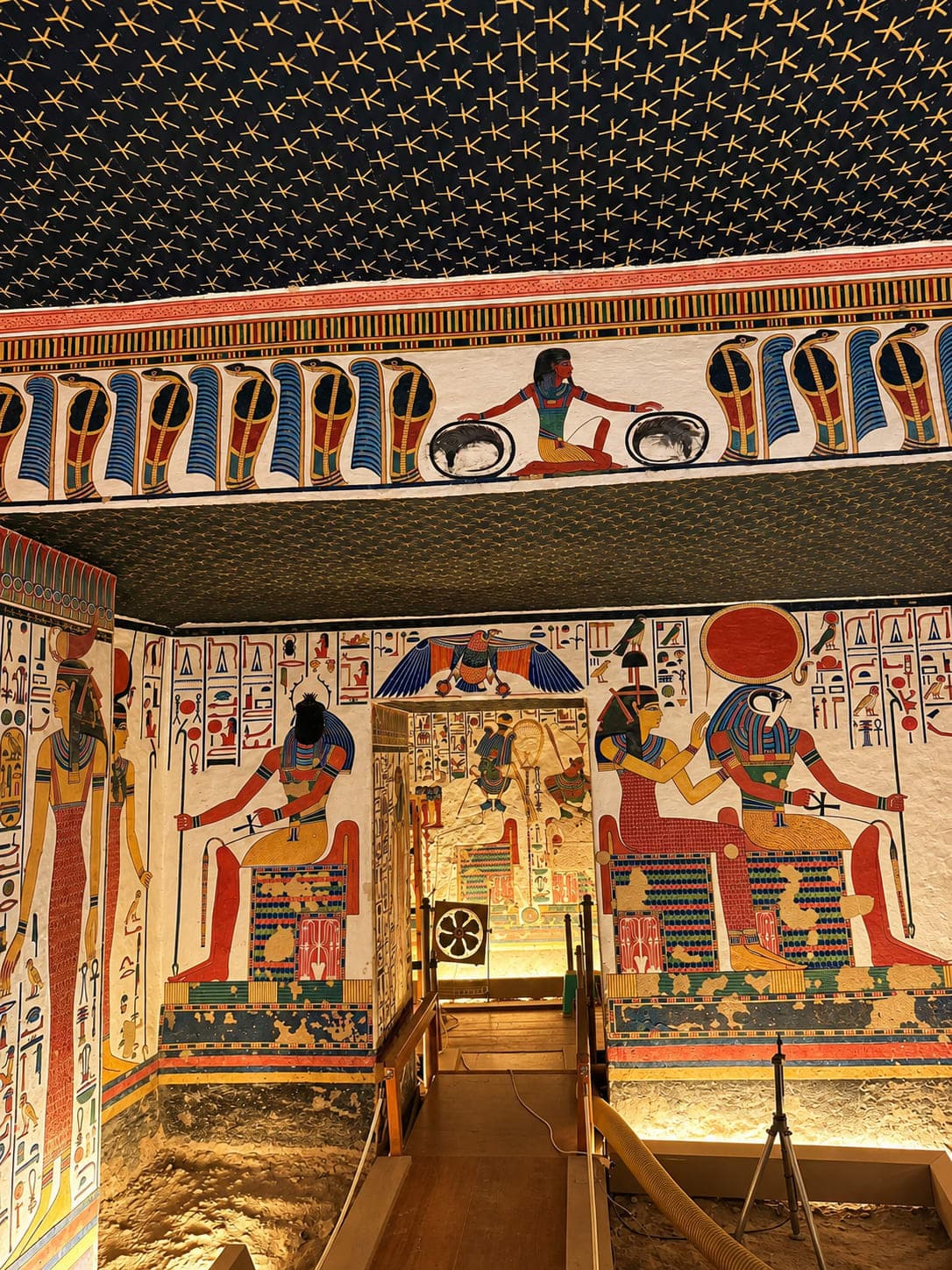
Painted reliefs in the second court, colour still on the stone
What else is inside the walls
- The palace. On the south side of the first court, low walls mark the ceremonial palace where the king stayed during festivals. There is a "window of appearances" between palace and court, through which he showed himself and handed down rewards.
- The chapels of the God's Wives of Amun. Just inside the gate, small and easily walked past. These were the burial chapels of a line of royal women who held real political power in Thebes in the late period — a rare piece of architecture built for women's authority rather than a king's.
- The Coptic evidence. Look for crosses cut into columns, and the plastered-over faces of gods. The town of Djeme lived here for centuries; the temple did not so much get abandoned as get repurposed and then, eventually, dug out from under a village.
- The great inscriptions. The calendar of festivals on the outer wall is one of the most detailed accounts of religious practice to survive from ancient Egypt — what was offered, on which day, in what quantity.
The king who built it, and how his reign ended
Ramesses III is worth knowing about before you walk in, because the temple is an argument he was making about himself.
He came to the throne around 1184 BC, when Egypt's position was genuinely precarious, and he spent his reign defending it — against Libyans in the west and twice against the Sea Peoples. He won, and the walls here say so at length. He deliberately modelled himself on Ramesses II, taking the name, copying the building style, even naming his children after his predecessor's. Medinet Habu is a smaller, later, tighter echo of the Ramesseum a few kilometres away.
Two things happened at the end that make the site unusually human.
The first recorded strike in history. In year 29 of his reign, the workmen of Deir el-Medina — the village that cut the royal tombs — were not paid their grain rations on time. They downed tools, walked out, and staged sit-ins at the mortuary temples, including this one. The event is documented on a papyrus now in Turin, in administrative detail: who complained, what was said, how the rations were eventually delivered. It is the earliest labour dispute anybody wrote down.
The harem conspiracy. A secondary wife named Tiye plotted with palace officials to kill the king and put her son on the throne. The trial documents survive: the accused were tried, convicted, and executed or forced to suicide. For a long time it was unclear whether the plot succeeded. Then in 2012 a CT scan of the king's mummy found a deep cut across the throat, made before death and hidden by the wrappings. It did succeed.
None of this is on the walls, which is the point — the walls show a triumphant god-king. The papyri show an administration that could not pay its workers and a palace that murdered him. Standing in the first court with both in mind is a better visit than either alone.

Luxor Temple after dark, on the other bank
How to fit it in
Medinet Habu takes an hour and a half if you look properly, and it is at its best in the late afternoon, which is the opposite of most west bank advice. The reason is the light: the reliefs are cut into the stone, and low, raking sun throws the carving into relief in a way that midday sun flattens completely. It is also the emptiest part of an already empty site.
The pairing that works is the Valley of the Kings at opening time, Hatshepsut afterwards, a proper break through the heat of the day, and Medinet Habu at four when the light comes round. Anyone attempting all three back to back at noon in summer is doing none of them well.
Practically: the ticket is bought at the main west bank ticket office or at the gate depending on the season; there is very little shade inside; and the site is large and flat, so it walks easily but there is nowhere to sit.
Who should go, and who should not
Go if you have more than one day on the west bank, if painted decoration is what you came to Egypt for, or if you have seen Karnak and found yourself wondering what it originally looked like. Also go if you dislike crowds: on an ordinary afternoon there may be a couple of dozen people in the whole enclosure.
Skip it if you have exactly one day and have not yet seen the Valley of the Kings or Hatshepsut. Those are the once-in-a-lifetime sights, and a single day does not stretch to a fourth stop done properly. This is a second-visit temple, and second visits are exactly who it rewards.

The Valley of the Kings — the other half of a proper west bank day