
Destinations · Oct 11, 2026
Louvre Abu Dhabi: A Visitor's Guide to the Dome, the Galleries and Saadiyat
Is the Louvre Abu Dhabi worth it, how long to allow, and how to pair it with the Grand Mosque

The Louvre Abu Dhabi is the building most people picture when they think of Abu Dhabi after the Grand Mosque: a flat, silver dome that seems to float over the sea on the edge of Saadiyat Island. It is also a serious museum, not just a photo stop. This guide covers what the dome is, how the galleries are laid out, a few objects worth looking for, how long you really need, and how the visit fits into a day that starts at Sheikh Zayed Grand Mosque. It is written for travellers based in Dubai or Abu Dhabi who are deciding whether the Louvre deserves a day of their holiday.
Why there is a Louvre in Abu Dhabi
The museum is the result of an agreement between the United Arab Emirates and France, and it opened in November 2017. The Louvre name is used under that agreement, and French museums lend works to Abu Dhabi alongside the museum's own growing collection. What makes it different from the Louvre in Paris is the idea behind it. It calls itself a universal museum: rather than giving each civilisation its own wing, it places objects from different parts of the world next to each other when they come from the same period or answer the same question. A gold mask from one continent may sit beside a funerary figure from another, so you see how people far apart were dealing with the same things at the same time.
That approach is the main reason to go. If you have visited the big encyclopaedic museums of Europe, you will find the Louvre Abu Dhabi smaller, but far easier to read in a few hours.
The dome and the "rain of light"
The building was designed by the French architect Jean Nouvel. Its signature is the dome, 180 metres across, built up from eight layers of interlaced star-shaped openings. When the sun passes through the layers, it breaks into moving spots of light on the floors, walls and water below. Nouvel called this effect the "rain of light", and it is the thing most visitors remember. It changes through the day: soft and scattered in the morning, sharper and more contrasted in the early afternoon, and at night the dome is lit so that the stars glow from inside.
Under the dome is what the architect described as a museum city: a cluster of white, cube-like buildings, about fifty-five in all, of which twenty-three are galleries. Between them run small plazas and walkways, and the sea comes right up to the edges, so you often walk with water on one side. It is open air but shaded, and the breeze off the water makes it bearable even on warm days. Take time here before or after the galleries; the space under the dome is as much part of the visit as anything inside.
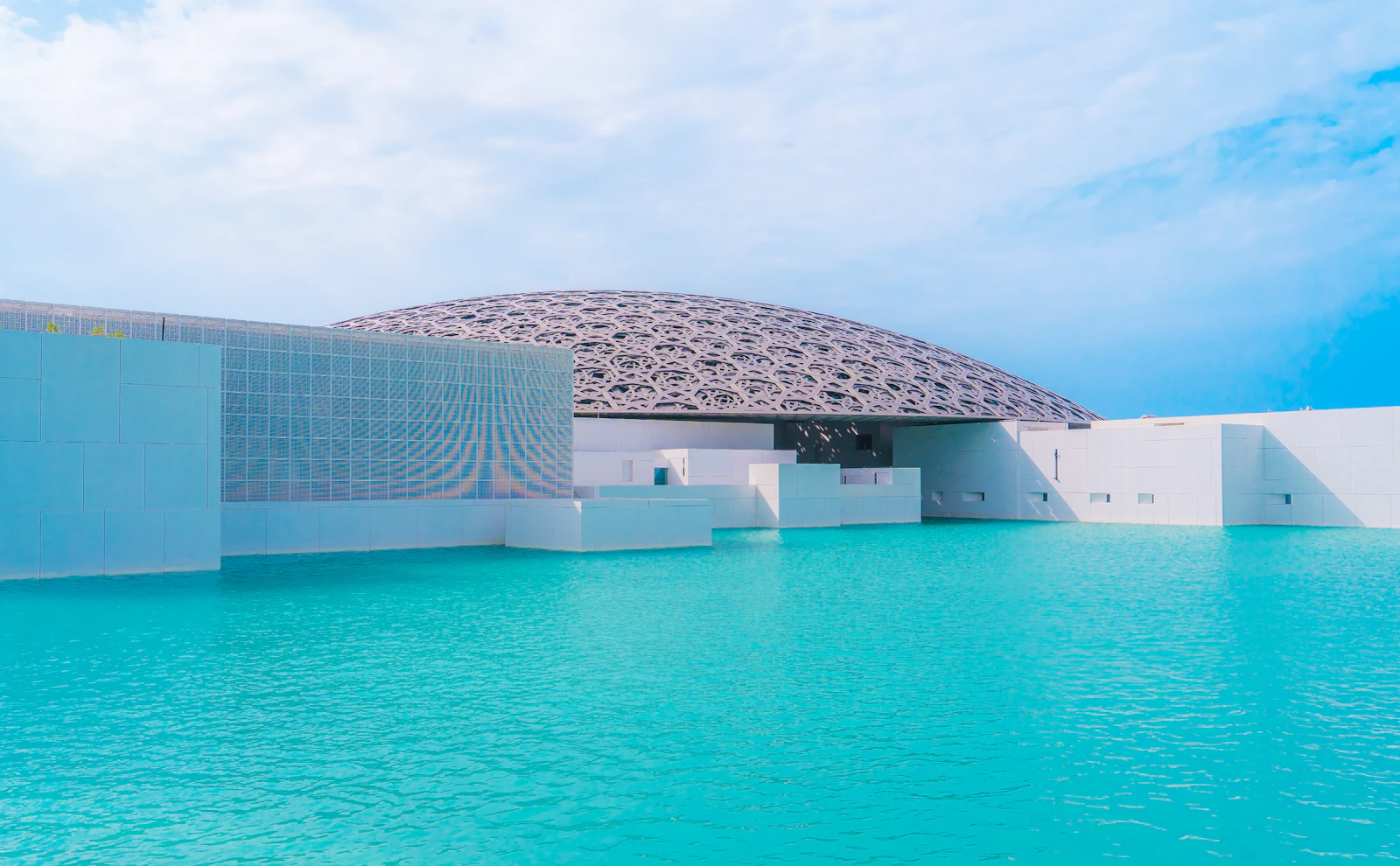
The dome of the Louvre Abu Dhabi seen across the water on Saadiyat Island — Photo: Unsplash
How the galleries are arranged
The permanent galleries tell one story in twelve chapters, in chronological order. You start with the first villages and the earliest settled communities, move through the first great powers, universal religions, trade routes, cosmography and the courts of kings, and finish with the modern world and a final chapter on a global stage in the twentieth and twenty-first centuries. Each chapter fills one or more of the cube buildings, and you pass under the dome between some of them, which gives the walk a natural rhythm.
Within each chapter, the objects are grouped by theme rather than by country. That is what makes the museum work for people who are not specialists: the labels explain why two very different objects have been placed together, and the comparison does most of the teaching. Follow the numbered order the first time. If you skip around, you lose the thread that holds the collection together.
Alongside the permanent galleries there is a space for temporary exhibitions and a Children's Museum with its own programme. Exhibitions change several times a year, so look at the official Louvre Abu Dhabi website before your visit to see what is on.

Book what you just read about
Explore related tours and check each trip for available booking options and inclusions.