Destinations · Sep 3, 2026
The Grand Egyptian Museum: what to see when you can't see it all
The largest museum in the world devoted to one civilisation, in sight of the pyramids it explains. Four things, twenty minutes each.
Helios Travels Team

The Grand Egyptian Museum opened fully on 1 November 2025, and it changed what a trip to Cairo means. It is the largest museum in the world dedicated to a single civilisation, it sits within sight of the pyramids it explains, and it holds the complete contents of Tutankhamun's tomb together for the first time since 1922.
It is also far too big to see. This guide is about seeing it well in the time you actually have.
The atrium of the Grand Egyptian Museum, with the colossal statue of Ramesses II
Where it is, and why that matters
The GEM stands on the edge of the Giza plateau, roughly two kilometres from the pyramids. That proximity is the whole design argument: the building is oriented so that the objects and the monuments they came from are in the same field of view. The Grand Staircase ends at a window framing the pyramids. No other museum on earth can do that.
Practically, it also means you should treat the GEM and Giza as one geographic block in your planning. Doing the museum on a different day from the plateau costs you an extra crossing of Cairo, and Cairo traffic is expensive in a way that has nothing to do with money.
How much time you actually need
- Two hours — the atrium, the Grand Staircase, and Tutankhamun. This is the minimum that isn't a waste, and it is what a day trip from Hurghada realistically allows.
- Four hours — the above plus the main chronological galleries and the solar boat. This is the sensible target.
- A full day — what the museum is actually built for, and what it rewards.
- Two visits — what anyone with a serious interest will end up wanting.
Decide your number before you go in and plan against it. The commonest mistake here is walking in without a plan, drifting for three hours, and leaving with a blur.
The five things to see if you see nothing else
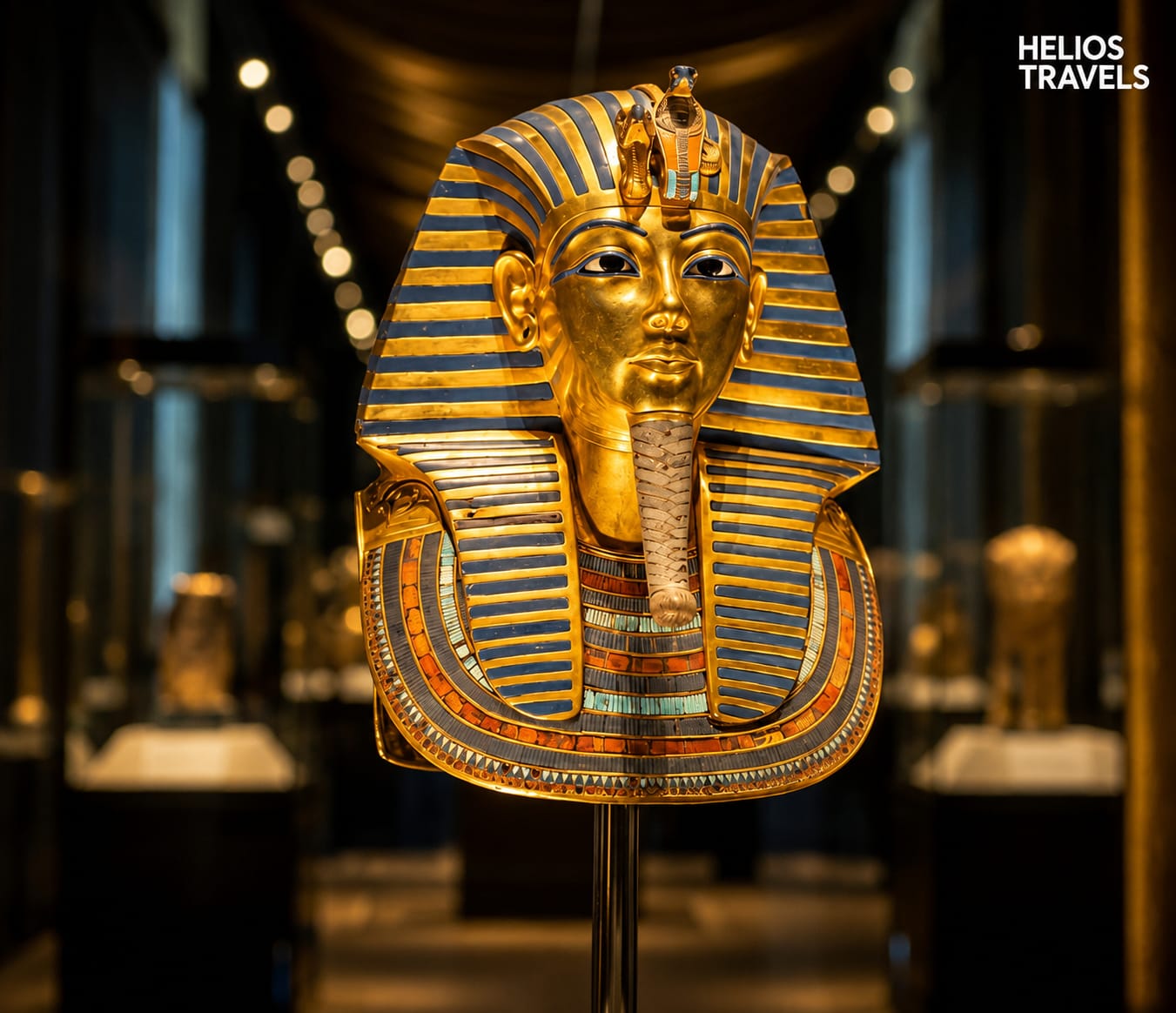
1. The colossal Ramesses II. Eleven metres of red granite, standing in the atrium. He spent decades in a traffic-choked square in central Cairo before being moved in 2006 and finally installed here. He is the first thing you meet and he resets your sense of scale for everything that follows.
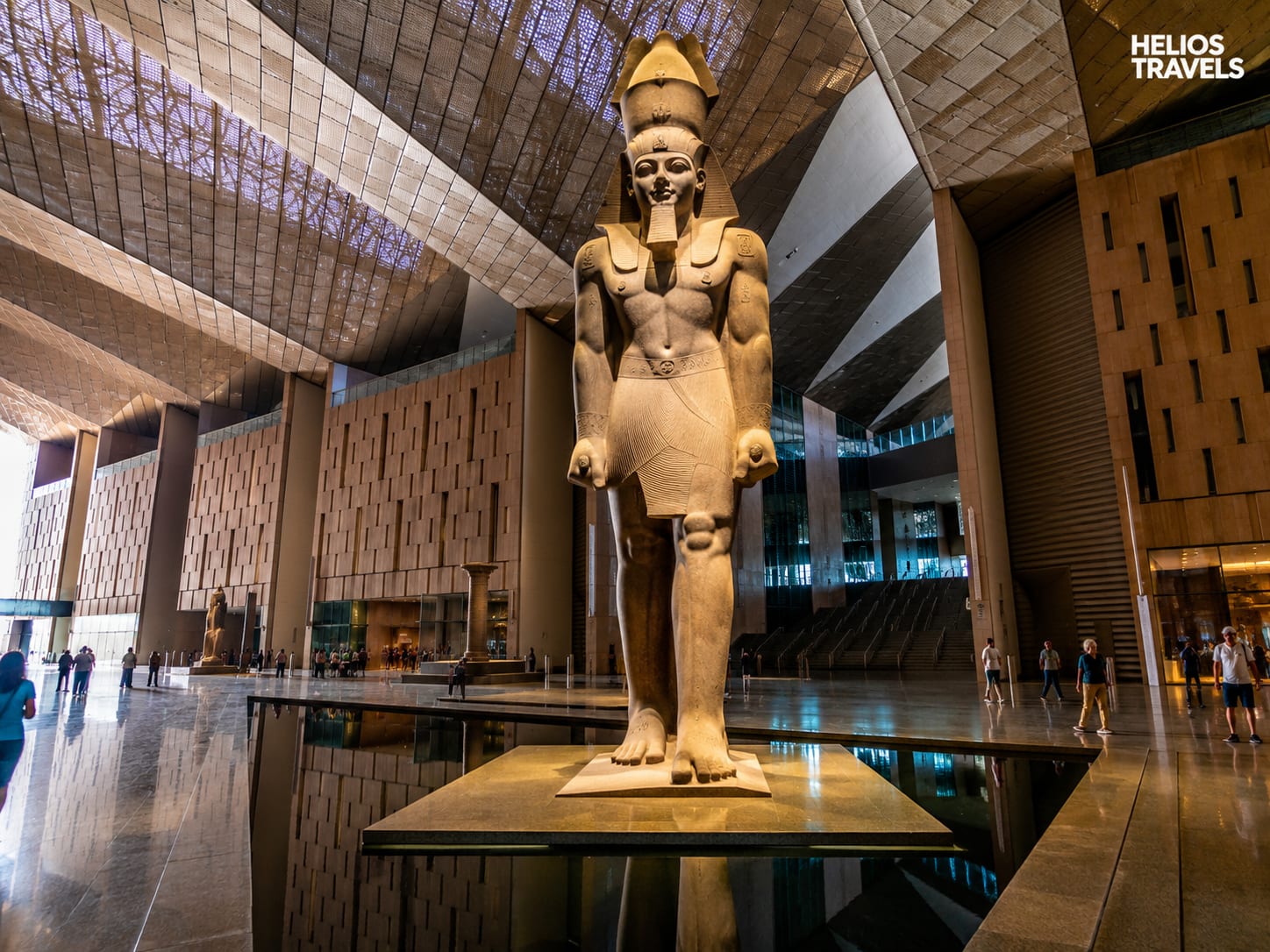
2. The Grand Staircase. A wide ascent lined with royal statuary, arranged so you climb through Egyptian history with kings and gods on either side. At the top, the window and the pyramids. Do not rush this — the staircase is an argument, not a corridor.
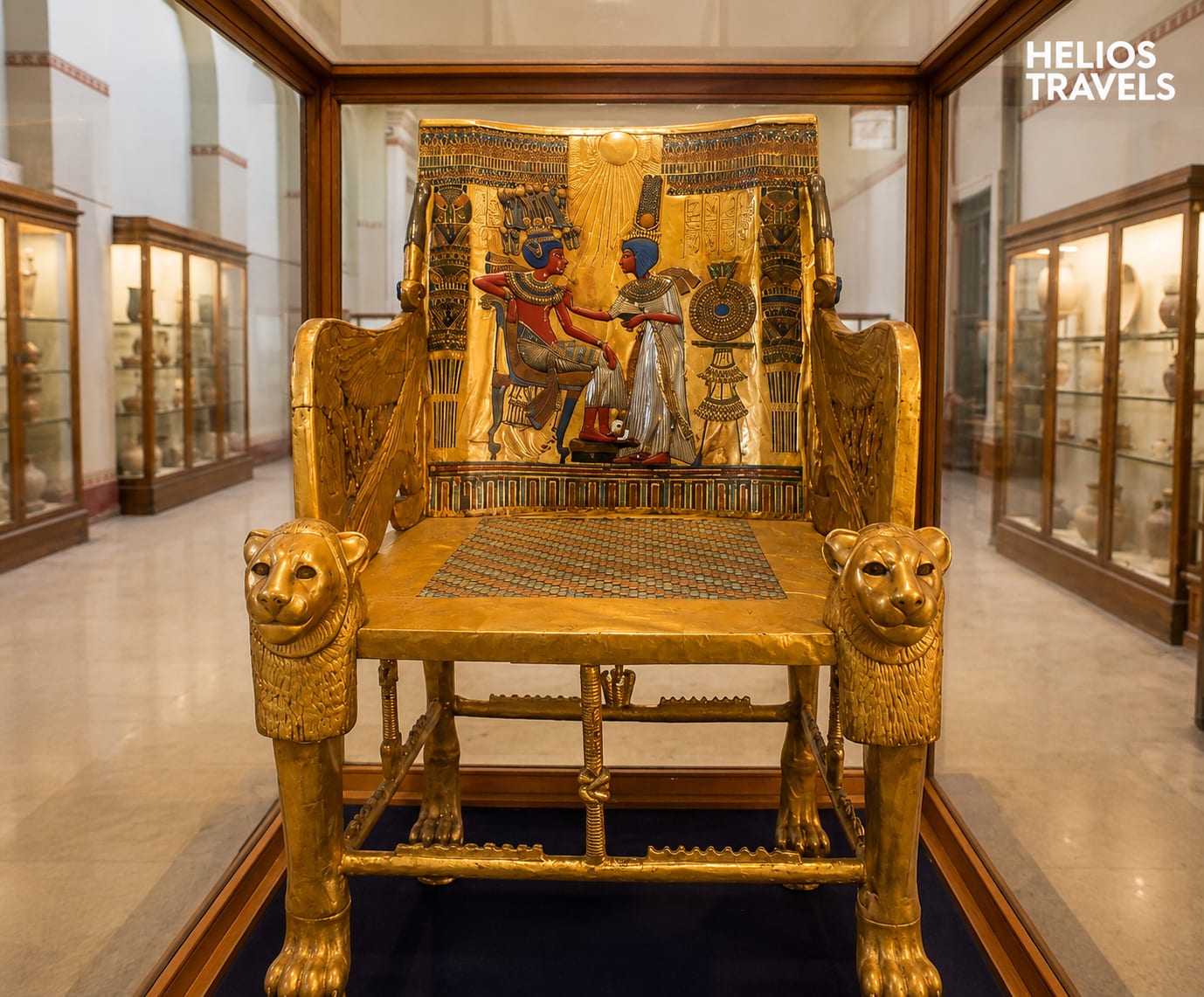
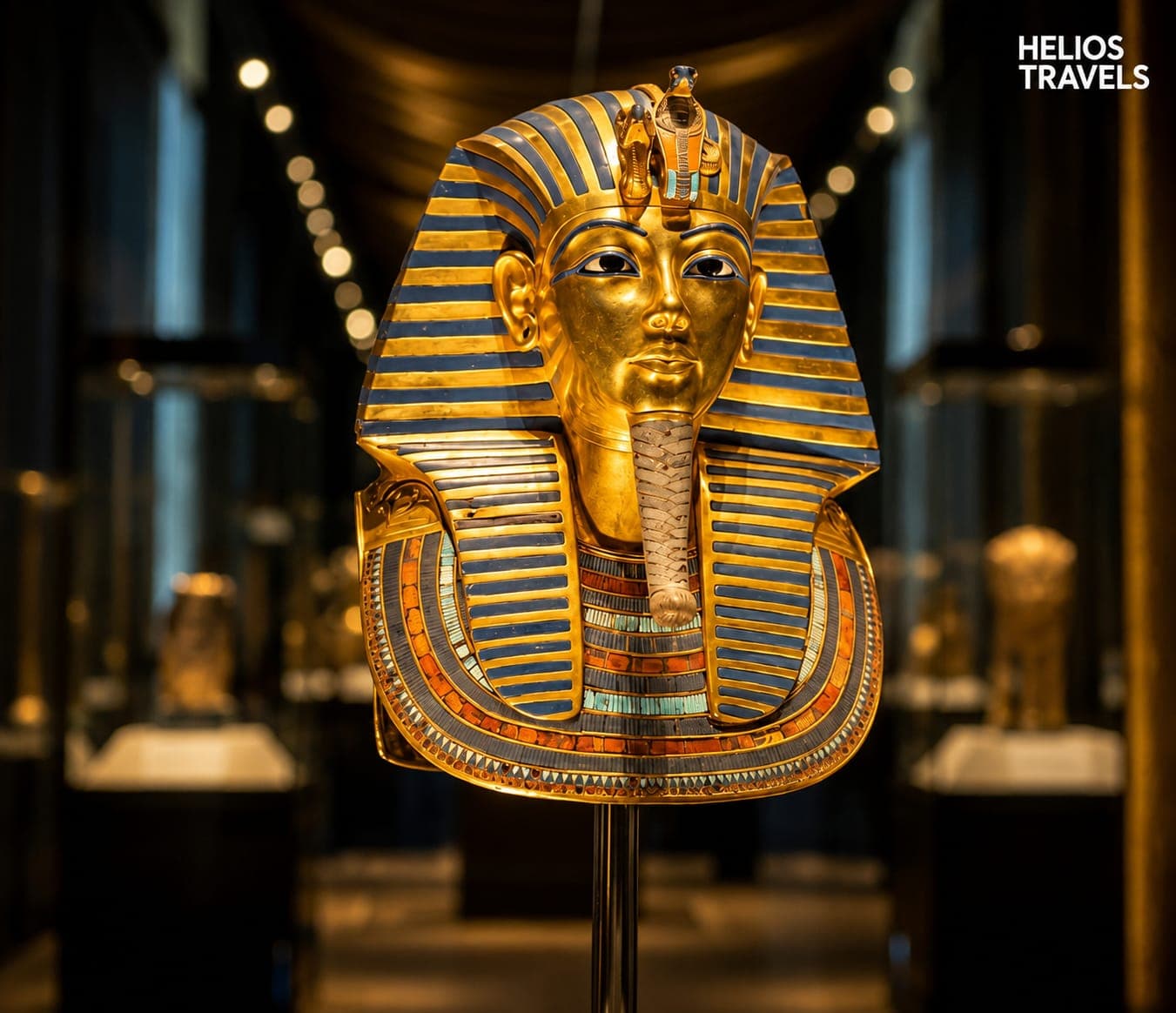
3. The Tutankhamun galleries. Over five thousand objects from a single tomb, shown together for the first time. The gold mask, yes — but also the beds, the chariots, the folding camp furniture, the walking sticks, the gloves, the board games. What lands is not the wealth but the domesticity: a young man's possessions, packed for a journey.
4. Khufu's solar boat. A cedar vessel over forty metres long, dismantled and buried in a sealed pit beside the Great Pyramid around 2500 BC, and reassembled from more than a thousand pieces. It is the oldest large boat that survives anywhere.
5. The hanging obelisk. Outside the entrance, a granite obelisk of Ramesses II raised so you can walk beneath it and see the base — where the king's cartouche is carved on the underside, a face nobody was ever meant to see.
The Grand Staircase of the Grand Egyptian Museum, lined with royal statuary
The question everyone asks: is the mask here?
Yes. Tutankhamun's gold funerary mask is at the GEM, with the rest of the tomb assemblage.
Two related things confuse people, and both are worth knowing before you plan a Cairo itinerary:
- The royal mummies are not here. They are at the National Museum of Egyptian Civilization in Fustat, where they moved in April 2021 in the televised procession known as the Pharaohs' Golden Parade. If you want to see Ramesses II's face, that is a different museum in a different part of the city.
- Tutankhamun's own mummy is in his tomb, in the Valley of the Kings at Luxor, in a climate-controlled case. It never left.
So the boy king is now in three places: his body in Luxor, his possessions at Giza, and neither in Tahrir.
What about the old Egyptian Museum in Tahrir?
Still open, and still worth going to — but understand that it is now a different proposition.
Tahrir is the 1902 museum: high ceilings, wooden cases, handwritten labels, objects crowded together, dust in the light. Much of the star material has moved to the GEM and to Fustat, and what remains is a vast, unglamorous, densely packed collection in a building that is itself a historical artefact.
Some visitors find it disappointing after the GEM. Others find it far more moving — the GEM is a designed experience, whereas Tahrir feels like being let into a storeroom. If you have time for both, do the GEM first and Tahrir second, and go to Tahrir for the atmosphere rather than the highlights.

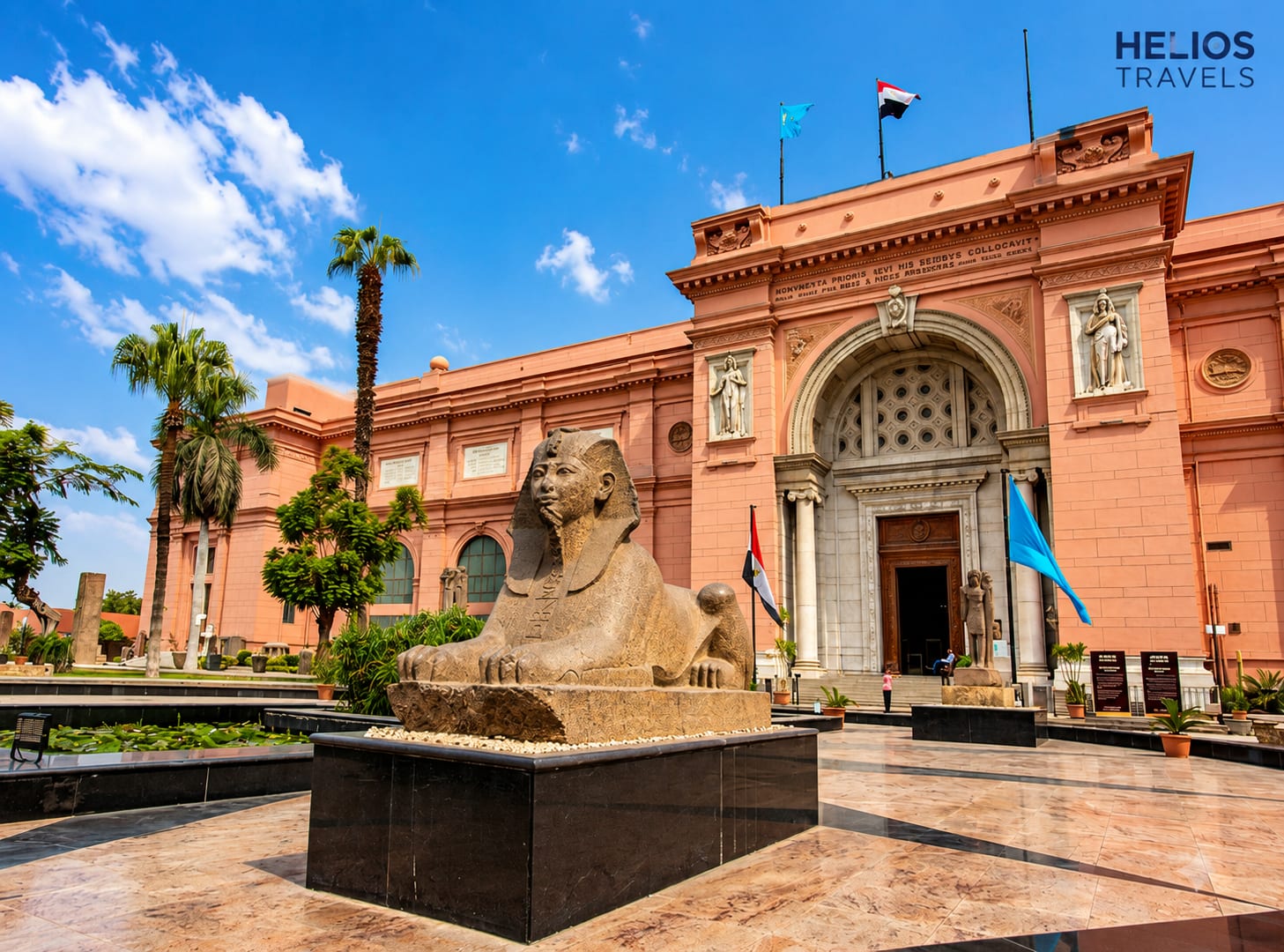
The old Egyptian Museum in Tahrir Square, Cairo
The building is part of the exhibit
The GEM took decades to build, and it shows in a way that is worth noticing rather than walking past.
The front elevation is a vast translucent wall of triangular stone panels — a Sierpinski pattern, a triangle subdivided into ever-smaller triangles — which catches the light differently through the day and echoes the pyramid geometry without imitating it. The building's footprint is aligned on the pyramids themselves, and the whole complex steps up the escarpment so the galleries climb as you move through them.
That is why the Grand Staircase works. You are not walking up stairs to reach the next floor; you are being walked up a hill, past increasingly monumental statuary, towards a window that reveals the thing all of it was made for. It is theatre, and it is very good theatre.
Spend two minutes outside before you go in, and another two at the top of the staircase before you turn into the galleries. Those four minutes are the difference between visiting a collection and visiting a building that was designed around one.
Making it a proper Cairo museum day
If Egyptology is why you came, the GEM is one of three museums that now split what used to be in a single building — and they are in three different parts of the city.
- The GEM at Giza — Tutankhamun, the solar boat, the monumental sculpture, the design.
- The National Museum of Egyptian Civilization at Fustat — the royal mummies, in a deliberately quiet, dimly lit hall, plus a sweep through Egyptian history from prehistory to the present. It is a very different register: reverent rather than spectacular, and many visitors find it the more affecting of the two.
- The Egyptian Museum at Tahrir — the old collection, densely packed, atmospheric, unmodernised.
Two of those in one day is comfortable if you pick them well; three is a museum marathon that will defeat most people. The best pairing for a first visit is the GEM plus the pyramids, since they are two kilometres apart and explain each other. The best pairing for a second visit is NMEC plus Coptic and Islamic Cairo, which are on the same side of town.
Practical notes
- Book ahead where you can, and go on a weekday. Weekends and public holidays are markedly busier.
- Arrive early or late, not at midday. Tour groups from the Giza morning arrive in a wave around lunchtime.
- Wear proper shoes. The distances inside are real — this is a building measured in kilometres of walking, not rooms.
- There is a separate ticket for the Tutankhamun galleries on some ticket types. Check what yours covers before you queue.
- Photography without flash is generally permitted in the main galleries; rules for the Tutankhamun rooms are stricter and are enforced. Ask rather than assume.
- Eat before or inside. There is no casual food within walking distance outside the complex.
- Do the pyramids the same day if you can. Standing at the base of Khufu's pyramid in the morning and looking at the boat that was buried beside it in the afternoon is the best thing a day in Giza can give you.
The one piece of advice that matters most
Pick less. The instinct in a museum this size is to try to cover it, and covering it is impossible — you will walk eight kilometres and remember three objects, none of them well.
Choose four things before you arrive. Spend twenty minutes at each. Sit down in front of at least one of them. You will leave with more than the visitor who saw ten times as much at walking pace, and you will not be too tired to enjoy the pyramids you came for.

Gallery interior at the Grand Egyptian Museum