
Culture · Oct 15, 2026
Franconian Wine: Silvaner, the Bocksbeutel and Where to Taste It
A practical guide to the dry white wines of the River Main, from Würzburg wine taverns to the villages of the Mainschleife

Franconian wine is Germany's dry white wine from the River Main in northern Bavaria, best known for the Silvaner grape and the flat, round Bocksbeutel bottle. The easiest place to taste it is Würzburg, where historic estates pour by the glass in the old town and the vineyards start behind the railway station. Beyond the city, the wine villages along the Main loop and the Steigerwald hills make a rewarding day out.
What makes Franconian wine different
Franconia (Franken in German) is one of Germany's thirteen official wine regions, and one of the most continental: warm summers, cold winters and vineyards that follow the bends of the Main on steep, sun-facing slopes. Most of the wine is white, and most of it is made dry. Where many visitors associate German wine with sweetness, a typical Franconian glass is crisp, earthy and built for food.
The soils matter here more than in many regions. Around Würzburg the vines grow on shell limestone (Muschelkalk), which gives firm, mineral wines. Further east, in the Steigerwald, the soil is Keuper, a mix of marl and gypsum that tends to produce fuller, spicier Silvaner. Along the lower Main, towards Aschaffenburg, red sandstone dominates and red wines play a bigger part.
Silvaner: the signature grape
Silvaner has been grown in Franconia for centuries and is the grape most people mean when they talk about Frankenwein. It is not the most planted variety (Müller-Thurgau competes for that title), but it is the one the region is proudest of. Good Silvaner is quiet rather than showy: green apple, herbs, a hint of stone and a clean, dry finish. It is famous as the partner for white asparagus during the spring Spargel season, and it works equally well with fish, pork, and the hearty Franconian kitchen.
Other grapes you will see on lists include:
- Müller-Thurgau (also called Rivaner): light, easy, often the house wine.
- Bacchus: aromatic, with elderflower and tropical notes, popular as an aperitif.
- Riesling: grown on the warmest sites, such as Würzburger Stein.
- Domina, Spätburgunder and other reds: more common in the west of the region.
The Bocksbeutel
The Bocksbeutel is the flattened, round-bellied bottle that marks Franconian quality wine. Its shape is protected under EU rules, and only a few regions outside Franconia may use it. Not every Franconian wine is bottled this way, but when you see one, you can be fairly sure where it came from. It also makes a sturdy souvenir to carry home in hand luggage, as long as you respect airline liquid rules for cabin bags.
How to read a Franconian wine list
| Term | What it means |
|---|---|
| trocken | dry; the default style in Franconia |
| halbtrocken / feinherb | off-dry, a touch of sweetness |
| Schoppen | a glass of open wine, traditionally a quarter litre |
| Ortswein / Lagenwein | wine from one village / from one named vineyard |
| VDP.Grosse Lage | top single-vineyard classification used by member estates |
| Federweißer | young, partly fermented wine sold at harvest time |
Where to taste in Würzburg
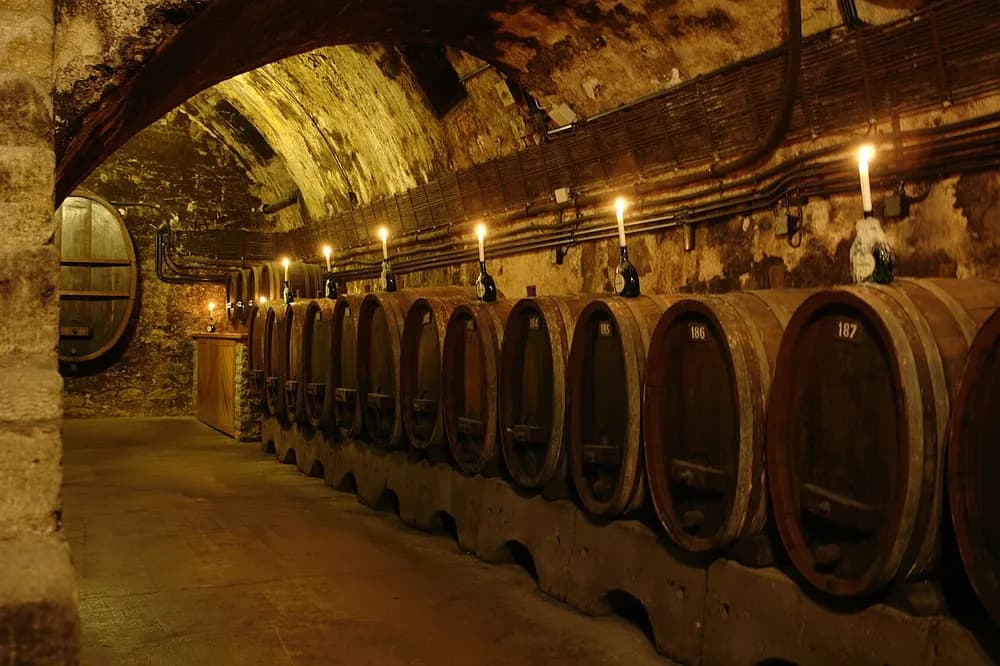
Würzburg is the capital of Franconian wine and the most convenient place to start. Three historic estates shape its wine life: the Bürgerspital and the Juliusspital, both centuries-old charitable foundations that fund their work partly through wine, and the Staatlicher Hofkeller, the Bavarian state estate whose cellars lie beneath the Residenz. All three have wine taverns or shops in the centre, and their cellar tours, when offered, are worth booking ahead.
Then there is the bridge. Buying a glass at the wine bars by the Old Main Bridge and drinking it at the parapet, the Brückenschoppen, is the most relaxed tasting in Germany. For a guided introduction, our premium Würzburg old town walk with three top Franconian wines combines the main sights with three tastings and the stories behind them.
If you want to see the vines themselves, the slopes below Marienberg Fortress are a short walk from the bridge. A vineyard walk below the fortress with Franconian wine takes you through the rows with views over the city and explains how the steep sites are worked.
Wine villages beyond the city
The prettiest wine landscape lies east of Würzburg, where the Main makes a tight loop (the Mainschleife) around Volkach.
- Randersacker and Sommerhausen: wine villages just south of Würzburg, easy by bike along the river.
- Volkach and Escherndorf: the Mainschleife, with the Vogelsburg viewpoint and the pilgrimage church Maria im Weingarten among the vines.
- Sommerach: a small walled wine village on an island in the Main.
- Iphofen: at the foot of the Steigerwald, known for powerful Keuper Silvaner.
Many of these villages are hard to combine without a car. Another option is to head south instead: our Romantic Road day trip from Würzburg with Franconian wine tasting pairs medieval towns with a tasting, so nobody in your group has to drive.
Heckenwirtschaften and wine festivals
A Heckenwirtschaft is a seasonal tavern run by a winemaker in their own courtyard or barn, allowed to open only for limited periods each year and to serve their own wine with simple food. They are the most local way to drink Franconian wine, and opening dates are usually posted on the village website or on a sign at the edge of the village.
From spring to autumn almost every wine village holds a Weinfest. Würzburg's own wine village on the market square, usually in late spring, is one of the best known. Exact dates change every year, so check the local tourist office before planning around one.
When to go
May and June bring asparagus with Silvaner and the first festivals. Summer is festival season. September and October are harvest time, with Federweißer, onion tart and golden vineyards. Winter is quiet in the villages, but the Würzburg estates stay open and the Christmas market serves mulled wine made from Franconian wine.
Practical tips
- Most taverns sell open wine by the glass, so you can taste several styles without buying a bottle.
- Germany's drink-driving limits are strict; if you plan to visit several villages, use the train, a bike or a guided trip.
- Many family estates sell directly from the cellar door; ringing ahead is polite, especially outside weekends.
- Taverns often close one or two days a week, commonly Monday or Tuesday.
FAQ
What is the most typical Franconian wine?
A dry Silvaner in a Bocksbeutel bottle. It is the grape and the bottle most closely linked with the region.
Is Franconian wine sweet?
Mostly not. The majority is made dry (trocken); off-dry styles exist and are labelled halbtrocken or feinherb.
Where is the best place to taste Franconian wine?
Würzburg is the easiest start, with historic estates in the old town and wine on the Old Main Bridge. For landscape, visit the Mainschleife around Volkach or Iphofen in the Steigerwald.
Can I visit the vineyards without a car?
Yes. The Würzburg vineyards are walkable from the centre, several wine villages have train stations, and the river cycle path links many others. A guided day trip is the simplest option for more remote villages.
Book what you just read about
Explore related tours and check each trip for available booking options and inclusions.
Würzburg Premium Old Town Walk with Three Top Franconian Wines
2 hours · Würzburg
€65/ person
See the tourWürzburg Vineyard Walk Below the Fortress with Franconian Wine
2 hours · Würzburg
€40/ person
See the tourRomantic Road Day Trip from Würzburg with Franconian Wine Tasting
8 hours · Würzburg
€89/ person
See the tour

