
Nile & Luxor · Sep 3, 2026
Karnak: how to walk two thousand years in two hours
Not a temple — two square kilometres built by thirty pharaohs. It only makes sense once you know it grows backwards in time.
Helios Travels Team
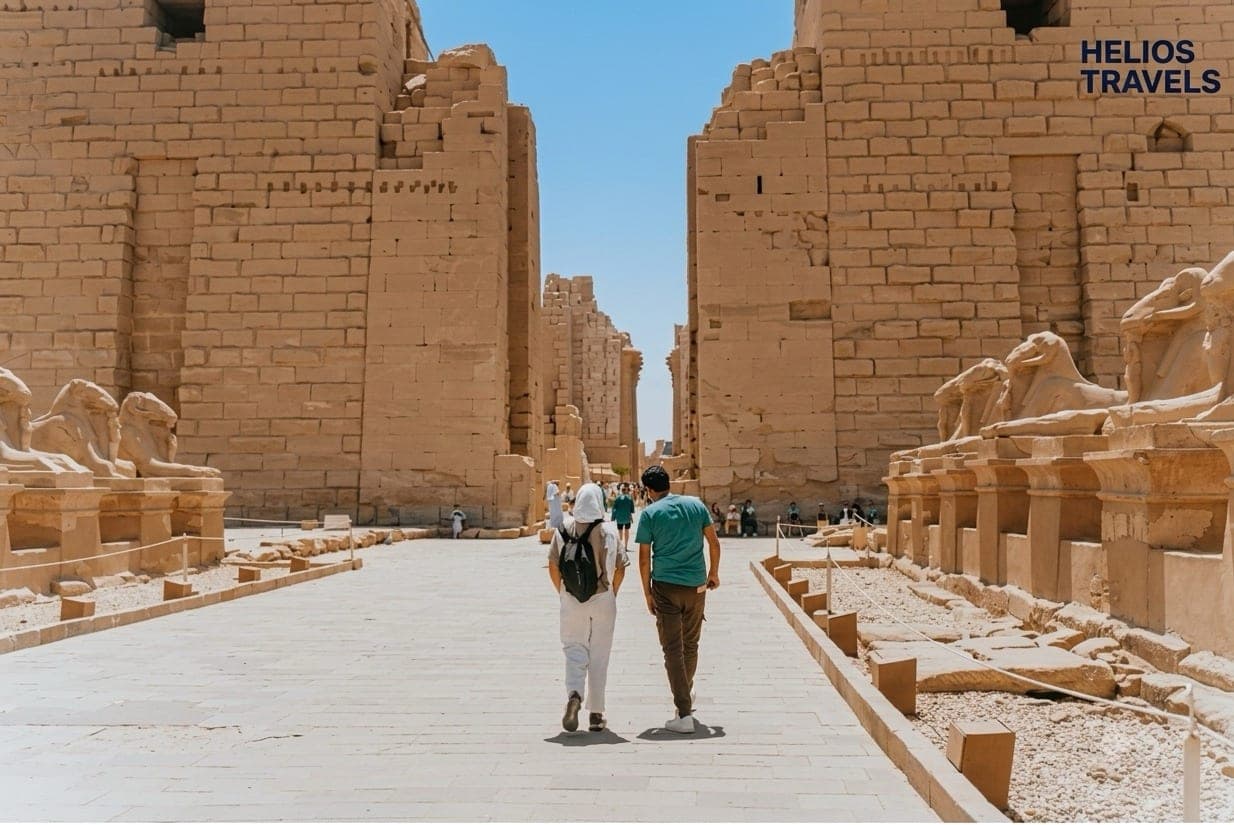
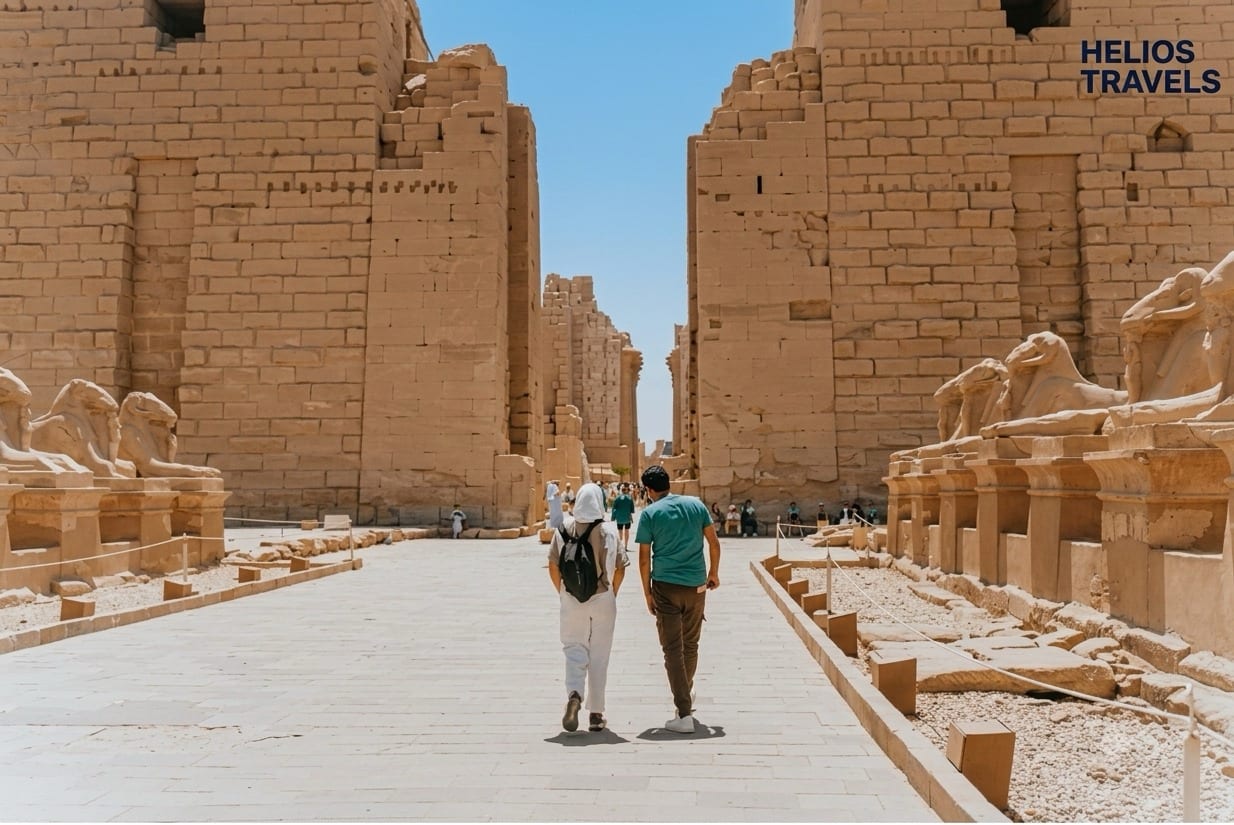
Karnak is not a temple. It is roughly two square kilometres of temples, chapels, pylons, obelisks and courts, built and rebuilt by something like thirty pharaohs across two thousand years — which is a longer span than separates us from the Roman empire.
Nobody sees it all, and trying is how people leave remembering only that it was big. Here is how to walk two thousand years in two hours.
The Great Hypostyle Hall at Karnak with its massive sandstone columns
The one idea that makes Karnak legible
Karnak was never designed. It accumulated.
Each pharaoh added to the front of it, building outward towards the Nile, so the temple grows backwards in time as you walk inwards. The pylon you enter through is among the newest and is unfinished; the small, plain rooms at the far end are the oldest. You are walking from roughly the Ptolemies back towards the Middle Kingdom, and the further in you go the earlier it gets.
Hold that one idea and the site stops being an overwhelming pile of stone and becomes something you can read.
The six things to actually stop at
1. The first pylon, and the ramp behind it. The entrance pylon was never finished, and behind its northern wing the ancient mudbrick construction ramp is still standing. This is the single most interesting object at Karnak and almost every group walks straight past it. It answers, physically and immediately, the question everyone asks about how the blocks got up there.
2. The Great Hypostyle Hall. 134 columns in sixteen rows, the twelve down the central aisle standing about twenty-one metres tall, built chiefly under Seti I and Ramesses II. It was roofed, and the only light came through clerestory windows at the top of the central aisle. Stand in the middle and look up: the design intent was a stone papyrus marsh, dark and dense, with light falling in shafts.
3. Hatshepsut's obelisk. About twenty-nine metres of single-piece red granite and the tallest ancient obelisk still standing in Egypt. Her successor could not easily topple it, so he walled the lower part in — which had the accidental effect of preserving the inscriptions better than anything left exposed.
4. The sacred lake. Where the priests purified themselves. It is also the best place to sit down, which after an hour of Karnak is not a small consideration.
5. The scarab. A granite scarab of Amenhotep III beside the lake, which visitors circle for luck. Join in; it costs nothing and it is a nice moment.
6. The Avenue of Sphinxes. The processional way running about 2.7 kilometres from Karnak to Luxor Temple, excavated over decades and reopened in November 2021. Twice a year the god's statue travelled down it. You can now walk it.
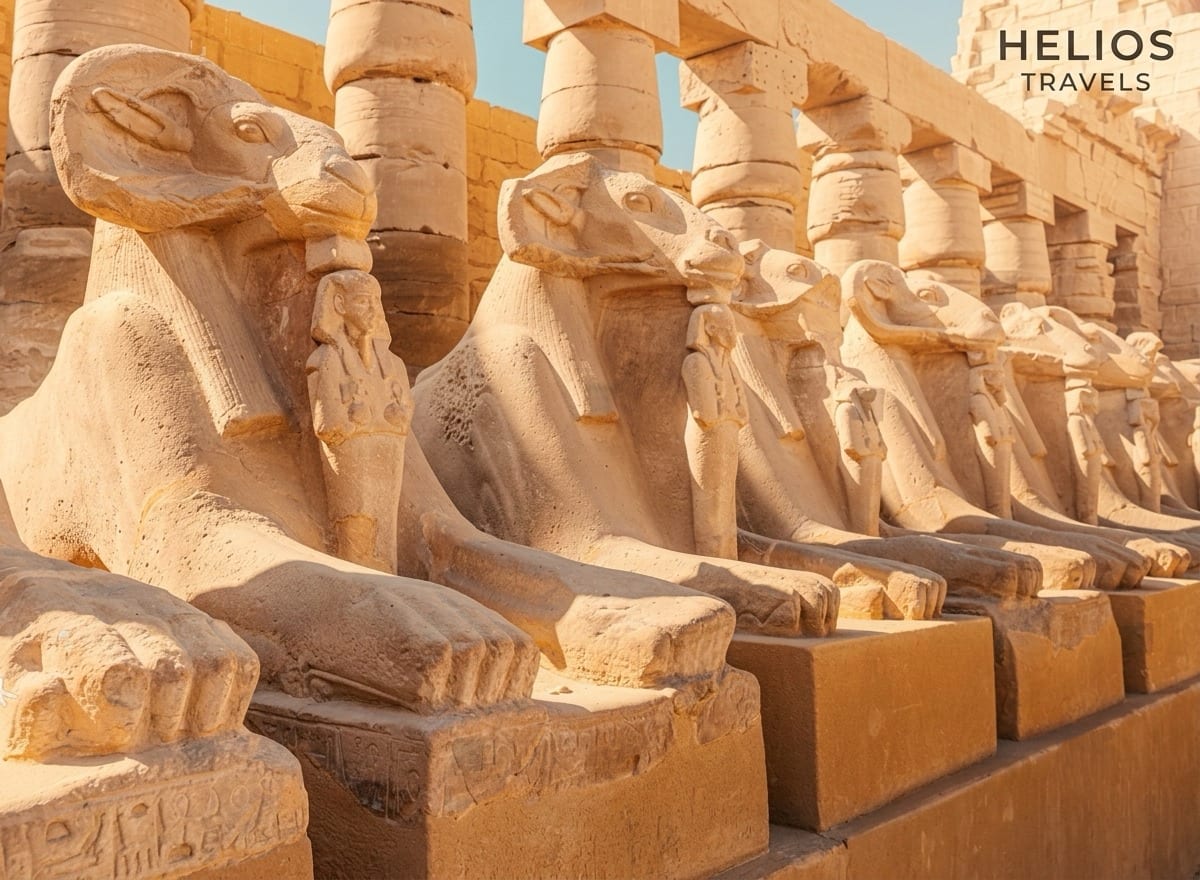
Ram-headed sphinxes lining the processional avenue at Karnak
What it was for
Karnak was the estate of Amun-Ra, and "estate" is the right word — it was less a church than a corporation. At its height the temple owned enormous tracts of farmland, herds, ships, mines and tens of thousands of workers. The priesthood of Amun became wealthy enough to rival the throne, which is a decent part of why Akhenaten moved the capital and the religion elsewhere, and why the restoration after him was so emphatic.
The building itself was not a public space. Ordinary Egyptians got as far as the outer courts. Beyond that the rooms get smaller, lower and darker as you approach the sanctuary, where the god's statue lived, was washed, dressed and fed daily by the high priest. That progressive narrowing is deliberate and you can feel it as you walk in — the architecture is doing the theology.
When to go
Early morning is best for heat and crowds. The site opens early, the coaches arrive later, and the low sun rakes along the columns in the hypostyle hall, which is when it photographs properly.
Late afternoon is the other good window: fewer people than mid-morning, warm light, and the sandstone goes orange.
Midday in summer is a mistake. The hall is roofless now, and the open courts have no shade at all.
There is also the sound and light show after dark, which divides opinion. The script is grandiose and the narration is very much of its era. But you walk through the hypostyle hall at night, lit, with almost nobody in it, and that part is genuinely worth the ticket even if the commentary is not.
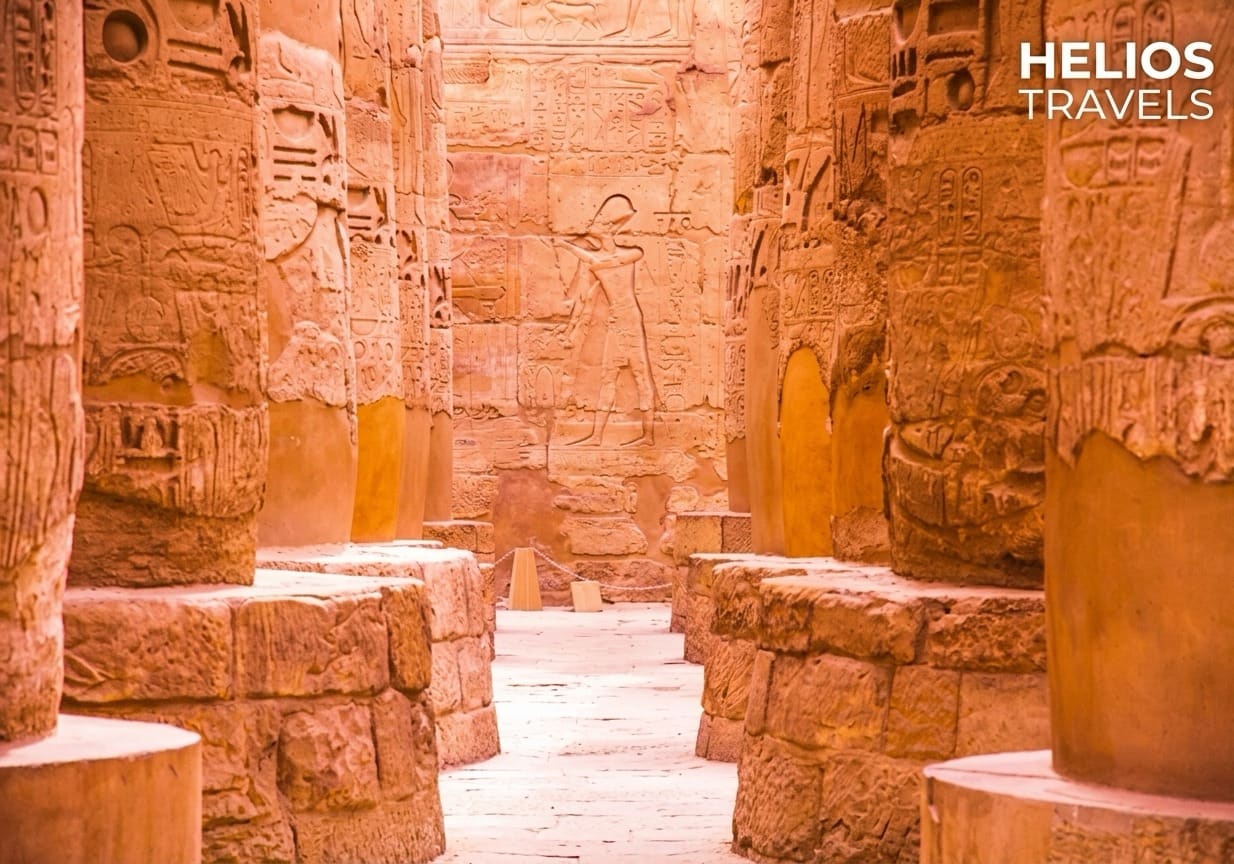
Sunlight falling between the columns of Karnak's hypostyle hall
Two hours, spent well
- 0:00 — Avenue of sphinxes and the first pylon. Find the mudbrick ramp behind the north wing.
- 0:15 — The great court, then into the Hypostyle Hall. Give it twenty-five minutes; it is the reason you came.
- 0:45 — Obelisks, then inward towards the sanctuary, noticing the rooms getting smaller.
- 1:10 — The festival hall of Thutmose III at the back, which almost nobody reaches.
- 1:30 — The sacred lake and the scarab. Sit down.
- 1:50 — Out through the open-air museum if it is open, which most tours skip.
Two hours is enough to see Karnak properly. Forty minutes, which is what a rushed day trip allocates, is enough to photograph it and remember nothing.
Karnak and Luxor Temple are one thing, not two
Three kilometres downstream sits Luxor Temple, and the two were built as a pair. The Avenue of Sphinxes connected them physically; the Opet festival connected them ritually.
Once a year, at the Nile flood, the statues of Amun, his consort Mut and their son Khonsu left Karnak and travelled — by river, or later along the avenue — to Luxor Temple, where the god and the king underwent a rite that renewed the king's divine authority for another year. Then they went home. The entire two-and-a-half-kilometre processional way exists to be walked down twice, by a statue, annually.
That is worth carrying with you, because it changes what Luxor Temple is. It is not a second, smaller Karnak. It is the destination — the place the whole apparatus at Karnak was pointing at.
Practically: see Karnak by day and Luxor Temple after dark. Luxor Temple is floodlit at night, sits in the middle of the living town rather than on an archaeological site, and the heat is gone. It is the best hour in Luxor and it costs nothing extra beyond staying the evening — which is, again, the argument for not doing Luxor as a day trip.
Practical notes
- Wear proper shoes. It is a couple of kilometres of walking on uneven stone and gravel.
- Water and a hat. The courts are unshaded.
- Allow for Luxor Temple separately. They are a pair and they are a different experience — Karnak by day, Luxor Temple lit after dark.
- A guide earns their fee here more than almost anywhere in Egypt, because the site is illegible without one and the good ones make the accumulation visible.
- Do not try to add Karnak to the end of a west bank morning. By one o'clock you will not have the attention for it. Karnak deserves its own half-day, which on a one-day trip means choosing.
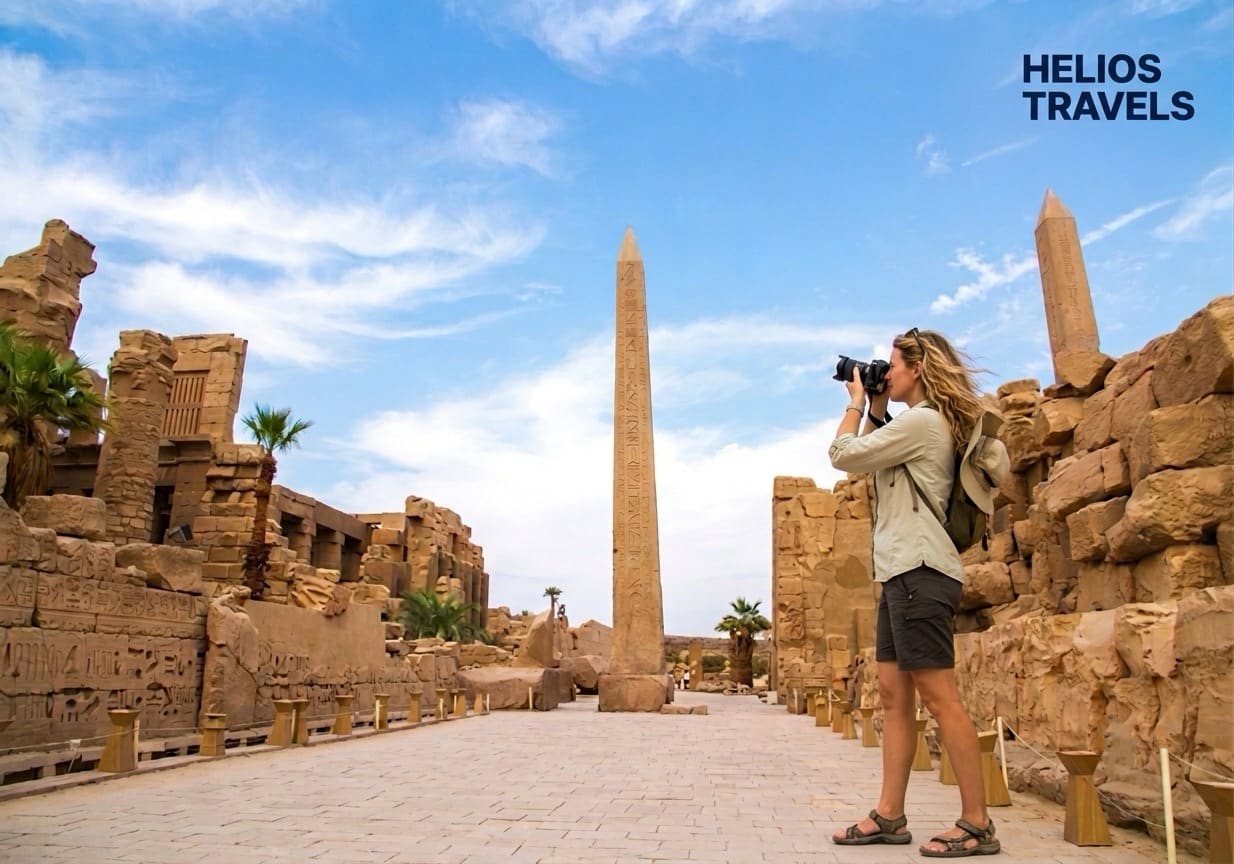
Colossal statuary and stonework in the courts of Karnak Temple