Nile & Luxor · Sep 9, 2026
Deir el-Bahari: the queen who erased herself, and was erased
The most architecturally daring building the ancient world left in Egypt — and the one most often seen at the worst possible hour.
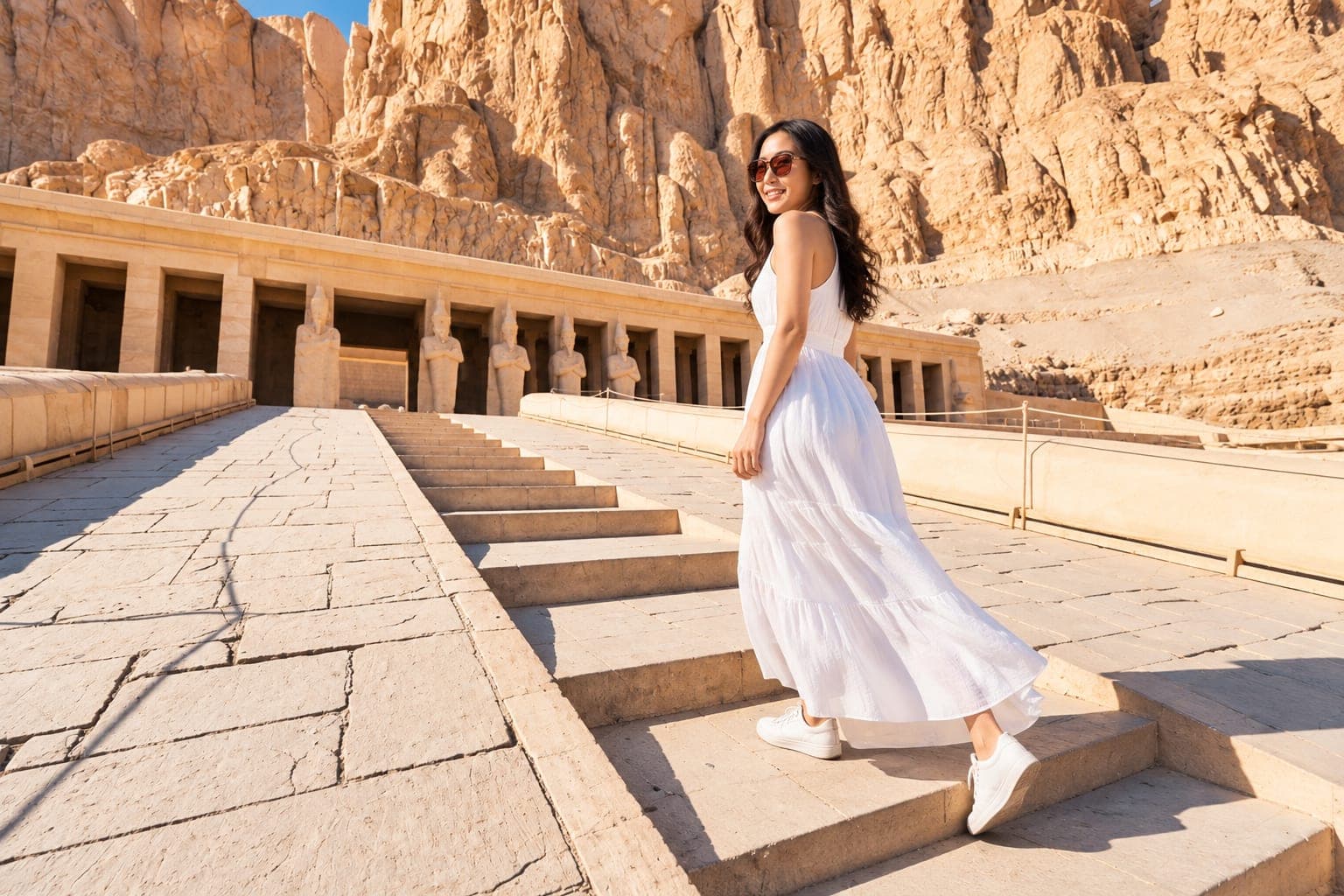
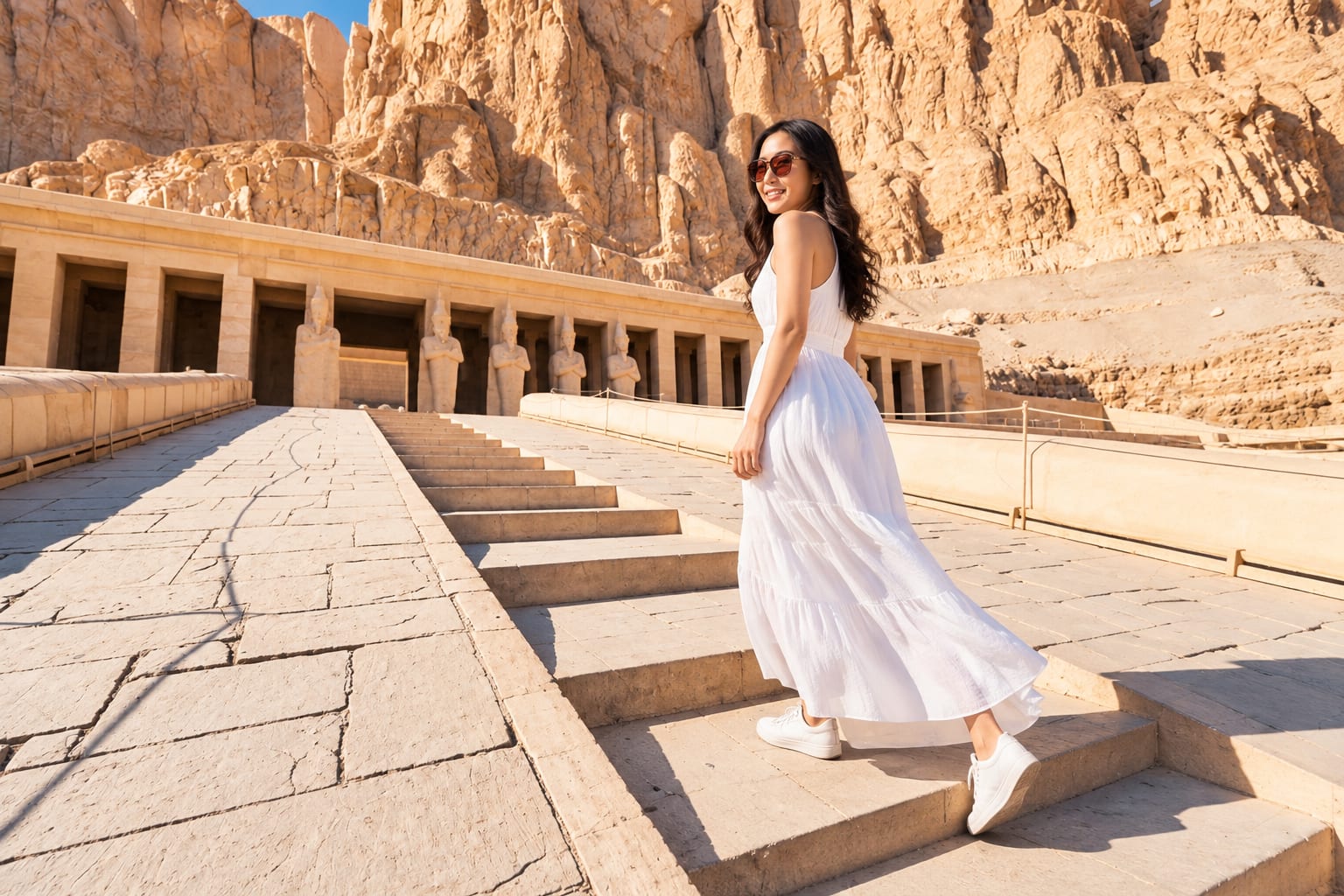
Deir el-Bahari is the most photographed building on the Theban west bank and the one visitors most often describe as underwhelming when they get there — because they arrive at eleven, in full sun, on a terrace with no shade, having already spent two hours in the Valley of the Kings.
Seen properly, and in the right hour, it is the most architecturally daring thing the ancient world left in Egypt.
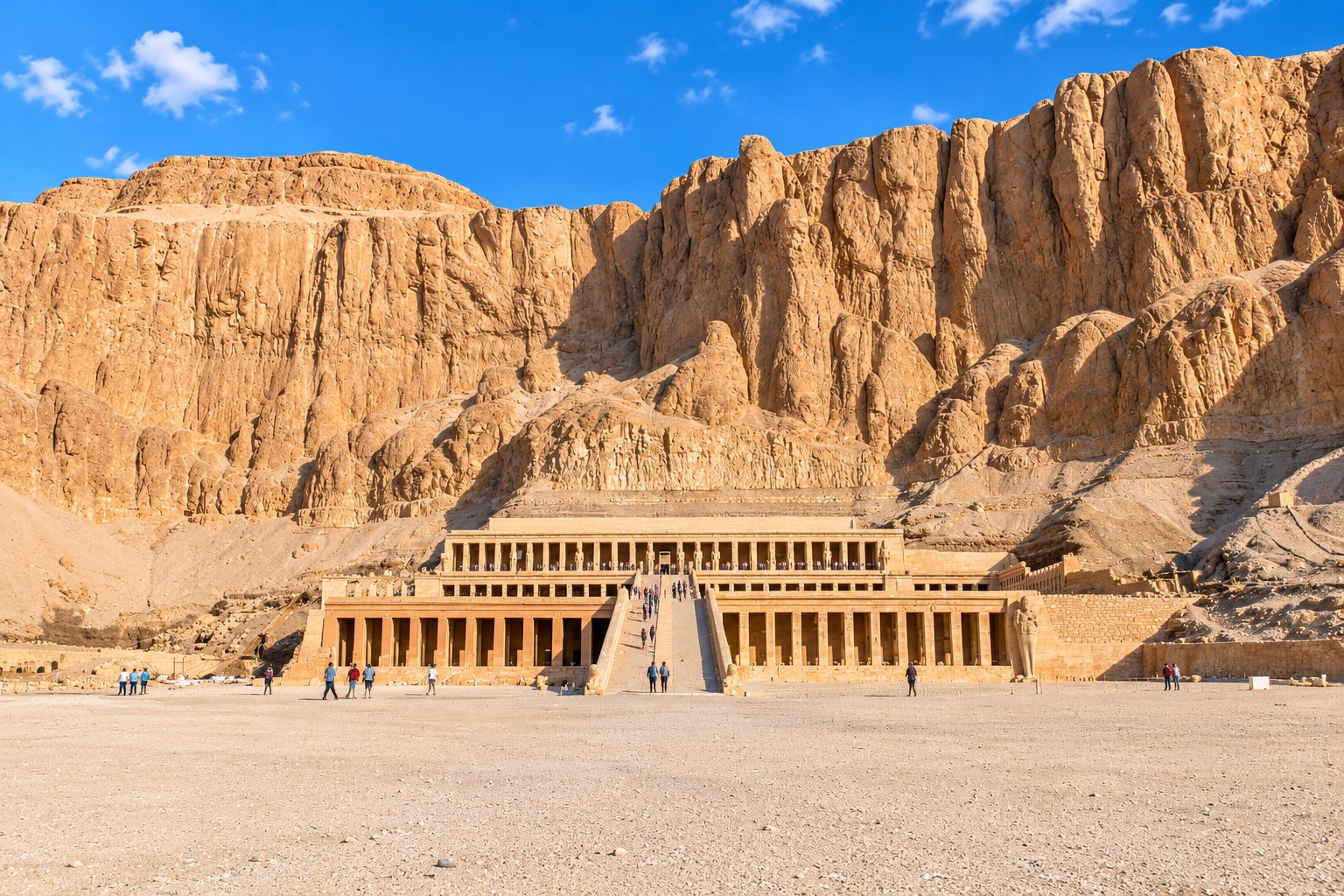
The terraced temple of Hatshepsut at Deir el-Bahari below the Theban cliffs
Why it looks nothing like other Egyptian temples
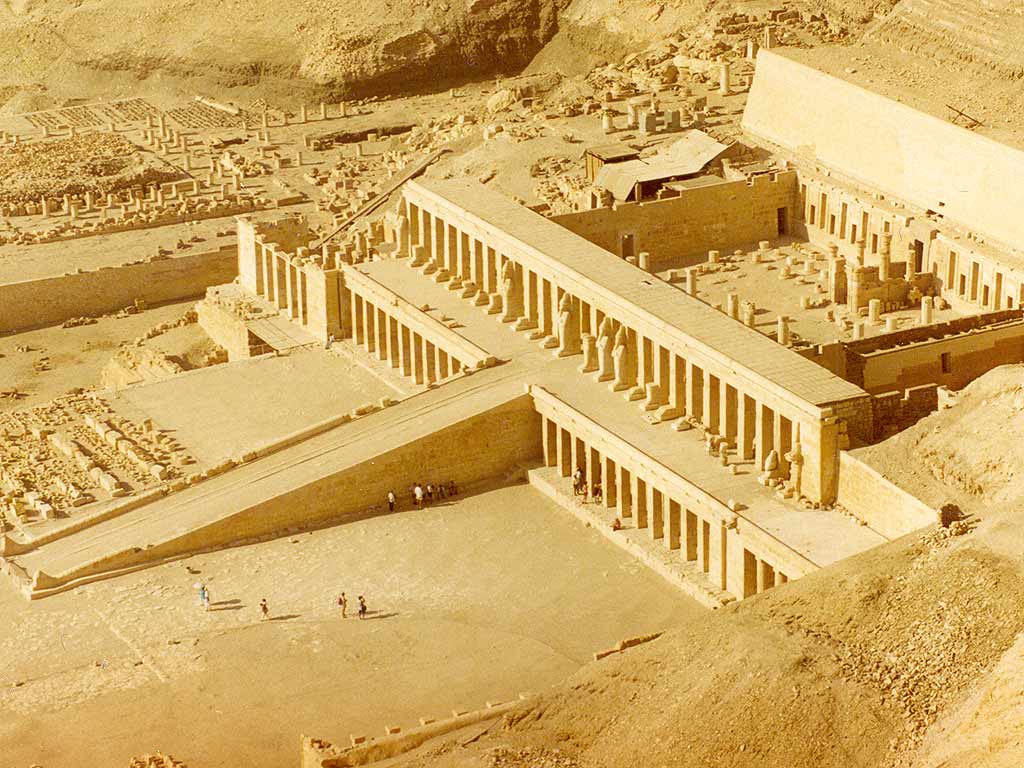
Almost every temple in Egypt is a dark, dense progression inward — pylon, courtyard, hypostyle hall, ever smaller and lower until the sanctuary. Deir el-Bahari does the opposite. It is open, horizontal and terraced, three colonnaded levels rising on ramps against a 300-metre cliff, using the rock face as the back wall of the composition.
Nothing else in Egypt looks like this. The design is credited to Senenmut, Hatshepsut's steward and one of the more intriguing figures of the period, and it borrows from an older Middle Kingdom temple that stood immediately beside it.
The thing to notice is the relationship to the cliff. The colonnades echo the vertical fluting of the rock behind them, so the building does not sit in front of the landscape — it completes it. Stand back at the bottom of the causeway rather than walking straight up, and that intent becomes obvious.
Who she was, and why it mattered
Hatshepsut ruled Egypt in the fifteenth century BC, in her own right, as pharaoh — not as a regent with a title, but as king, with the full titulary and the false beard in her statuary.
She came to power as regent for her young stepson Thutmose III and did not hand it back. Her reign was long, prosperous and notably unwarlike: the achievements she chose to record on these walls are not battles but trade and building.
Two sequences on the middle terrace carry the argument:
The Punt colonnade records a naval expedition to the land of Punt — probably on the Horn of Africa or the southern Red Sea coast — sent to bring back incense trees, ebony, ivory, gold and live myrrh saplings. The reliefs show the ships loaded, the houses of Punt on stilts, and, famously, the queen of Punt rendered with a frankness that has fascinated visitors since the nineteenth century. It is a trade report carved on a wall.
The birth colonnade makes the political case: it depicts Amun visiting her mother in the form of her father, making Hatshepsut literally the god's daughter. A woman ruling as king needed the strongest legitimacy available, and this is it, in stone, publicly.
Colonnade and reliefs on the middle terrace at Deir el-Bahari
The erasure
Look closely at the reliefs and you will find her chiselled out — figures hacked away, cartouches emptied, statues broken and buried in a pit near the causeway.
This happened under Thutmose III, the stepson she ruled over, but the timing complicates the obvious story: the erasure appears to have begun decades into his own successful reign, not in a fit of resentment at her death. The likelier explanation is dynastic rather than personal — removing a female king from the official record to secure a clean male succession for his own heir.
The effect is that Hatshepsut vanished from Egyptian history until the nineteenth century, when excavation and decipherment put her back. Standing in front of a deliberately emptied cartouche, knowing it was emptied to erase her and knowing we are looking at her temple anyway, is the most affecting thing on this terrace.
What to actually look at
- The approach. Stop at the bottom and look up before you ride the shuttle. This is the view the design was made for.
- The Punt reliefs, middle terrace, south colonnade. Find the ships and the stilt houses.
- The birth colonnade, middle terrace, north side.
- The Hathor chapel at the south end of the middle terrace — columns capped with Hathor's cow-eared head, and better-preserved colour than the open terraces.
- The Anubis chapel on the north side, which retains genuinely vivid paint because it is roofed and shaded.
- The upper terrace and the sanctuary, cut back into the cliff itself.
- The erased figures, once you know to look for them. They are everywhere.
Be aware that a great deal of what stands has been reconstructed, principally by a long-running Polish-Egyptian mission. That is not a criticism — the site was a ruin under rubble — but it explains why the masonry looks crisper than at other temples.
Senenmut, and the other story on this site
The architect gets a paragraph because he is one of the more human presences in a landscape of god-kings.
Senenmut rose from an ordinary background to become Hatshepsut's chief steward, tutor to her daughter Neferure, and the man credited with this temple. He accumulated an extraordinary number of titles for someone of no royal blood, and he did something almost nobody in his position dared: he had small images of himself carved into the temple, hidden behind doors in niches where they would be concealed when the doors stood open.
They were found anyway, which is how we know. Whether it was devotion, presumption, or a private joke at his own expense is not recoverable — but a courtier smuggling his own face into a royal temple is a very recognisable human act across three and a half thousand years.
His unfinished tomb lies just below the temple's causeway, and its ceiling carries one of the earliest astronomical charts known from Egypt. He disappears from the record before Hatshepsut's reign ends, and nobody knows why. It is the kind of loose thread that makes this site linger longer than a more complete one would.
One thing visitors sometimes ask about
This site was the location of an attack on tourists in November 1997, in which 62 people were killed. Visitors occasionally recognise the place and ask, so it is better said plainly once than left as an awkward silence.
Security at Egyptian monuments changed substantially afterwards, and the visible tourist-police presence at every major site dates largely from that period. There is nothing to see relating to it, and Egyptians who work here do not generally raise it. We mention it only because being the source that answers the question honestly is the point of these articles.
Practical notes — the heat is the whole problem
- Go second, immediately after the Valley of the Kings, and go early. These terraces face east and take the morning sun full on. At nine it is spectacular; by eleven it is an oven with a queue.
- There is no shade anywhere on the terraces. None. Hat, water, sunglasses, and do not plan to linger at midday.
- A shuttle runs from the car park to the base of the ramp. It is a genuinely useful few pounds in the heat.
- The ramps are long and steep-ish and there are no handrails in most places. Worth knowing if anyone in your group is unsteady.
- Allow 45 minutes to an hour. Longer if you want the chapels properly.
- Combine it with Medinet Habu or the Ramesseum, both minutes away and both with walls and roofs, so the morning finishes somewhere shaded.
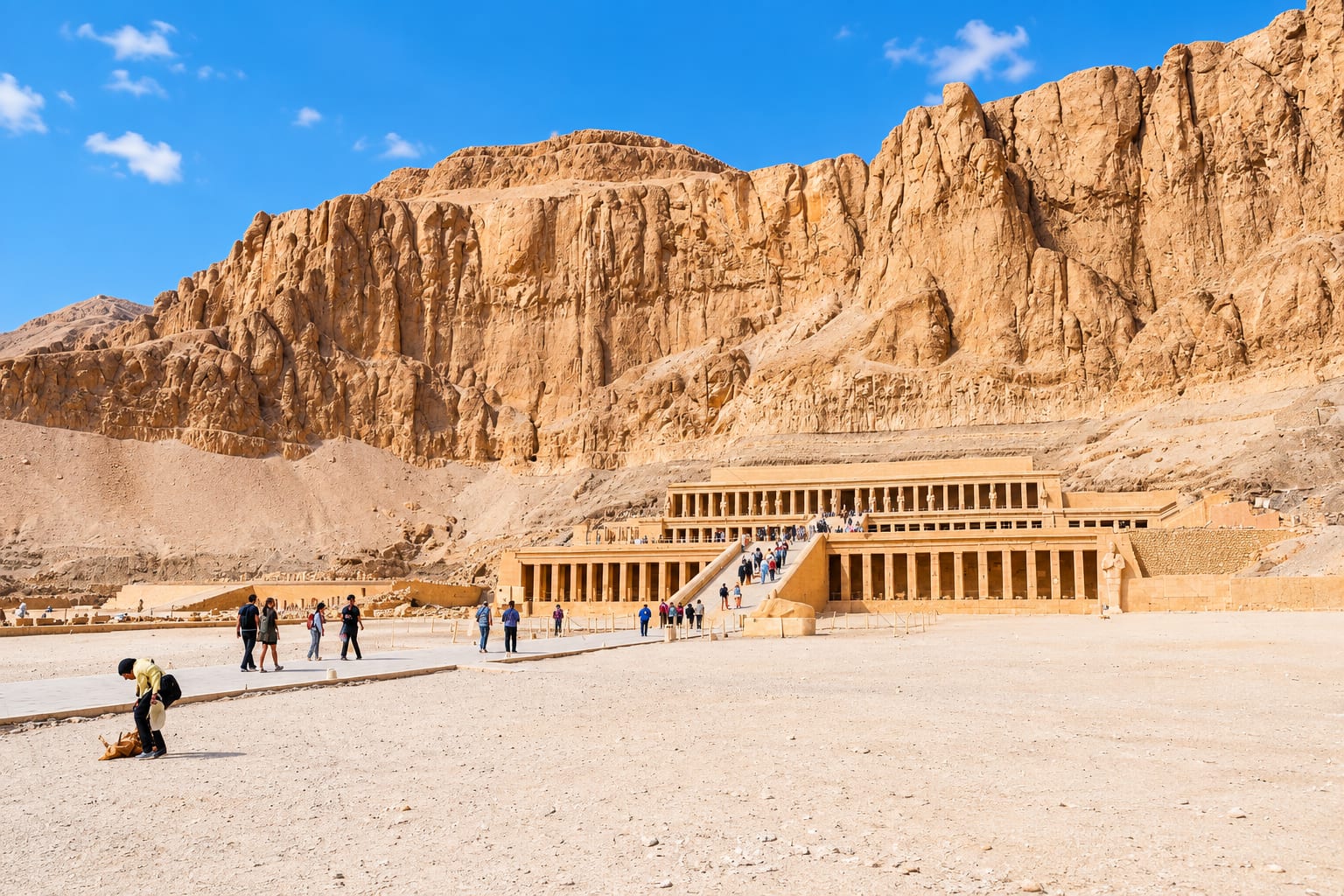
The upper terrace and colonnade of Hatshepsut's temple against the cliff
Book what you just read about
Tours from this article — private, with a licensed guide, and priced per person.
Luxor Day Tour — Karnak, Valley of the Kings & Free Nile Cruise
14 hours · Hurghada
$90/ person
See the tourLuxor in 2 Days — Both Banks of the Nile Without the Rush
2 days · Hurghada
$250/ person
See the tourLuxor Hot Air Balloon Sunrise & West Bank Temples — 2 Days
24 hours · Hurghada
$240/ person
See the tourLuxor with a Difference — Medinet Habu, Valley of the Queens & Nefertari
14 hours · Hurghada
$110/ person
See the tour